 wehub-resource-sync
ClawManager

A Kubernetes-native control plane for AI agent instance management, with governed AI access, runtime orchestration, and reusable resources across multiple agent runtimes.
Languages: English | Chinese | Japanese | Korean | Deutsch






Explore the Product | Team Workspaces | AI Gateway | Agent Control Plane | Runtime Integrations | Resource Management | Get Started

See ClawManager in 60 Seconds
A quick look at fast agent provisioning, skill management and scanning, and AI Gateway governance.
What's New
Recent highlights from the latest product and documentation updates.
- [2026-07-07] Added the Security Protection Platform (secplane) frontend — a comprehensive security console covering runtime defense (input/state/decision/output surface, asset tamper-proofing, human approval), host hardening & container isolation, outbound trusted-endpoint governance, policy governance, kill-switch/circuit-breaker, full-chain audit, SecureClaw data-and-component trust auditing, collaboration governance, and input detection. All 4 defense layers are accessible from a unified admin UI with full i18n for 5 languages.
- [2026-06-14] Added Lite / Pro runtime modes and rollout support, so Lite instances can run through shared gateway runtime pools while Pro instances keep dedicated desktop deployments for stronger isolation.
- [2026-05-18] Added the Team workspace MVP introduction and preview, covering one-click Team creation, OpenClaw member orchestration, Redis Team Bus injection, shared storage, member status, task dispatch, and event/result views.
- [2026-04-29] Added Hermes runtime integration support, including Webtop-based instance provisioning, Agent Control Plane registration, AI Gateway injection, channel and skill bootstrap, and
.hermesimport/export workflows. See the Hermes Runtime Guide. - [2026-04-08] Added skill management and skill scanning workflows to the platform, via Merged PR #52.
- [2026-03-26] AI Gateway documentation was refreshed with stronger coverage for model governance, audit and trace, cost accounting, and risk control. See the AI Gateway Guide.
- [2026-03-20] ClawManager evolved into a broader control plane for AI agent workspaces, with stronger runtime control, reusable resources, and security scanning workflows.
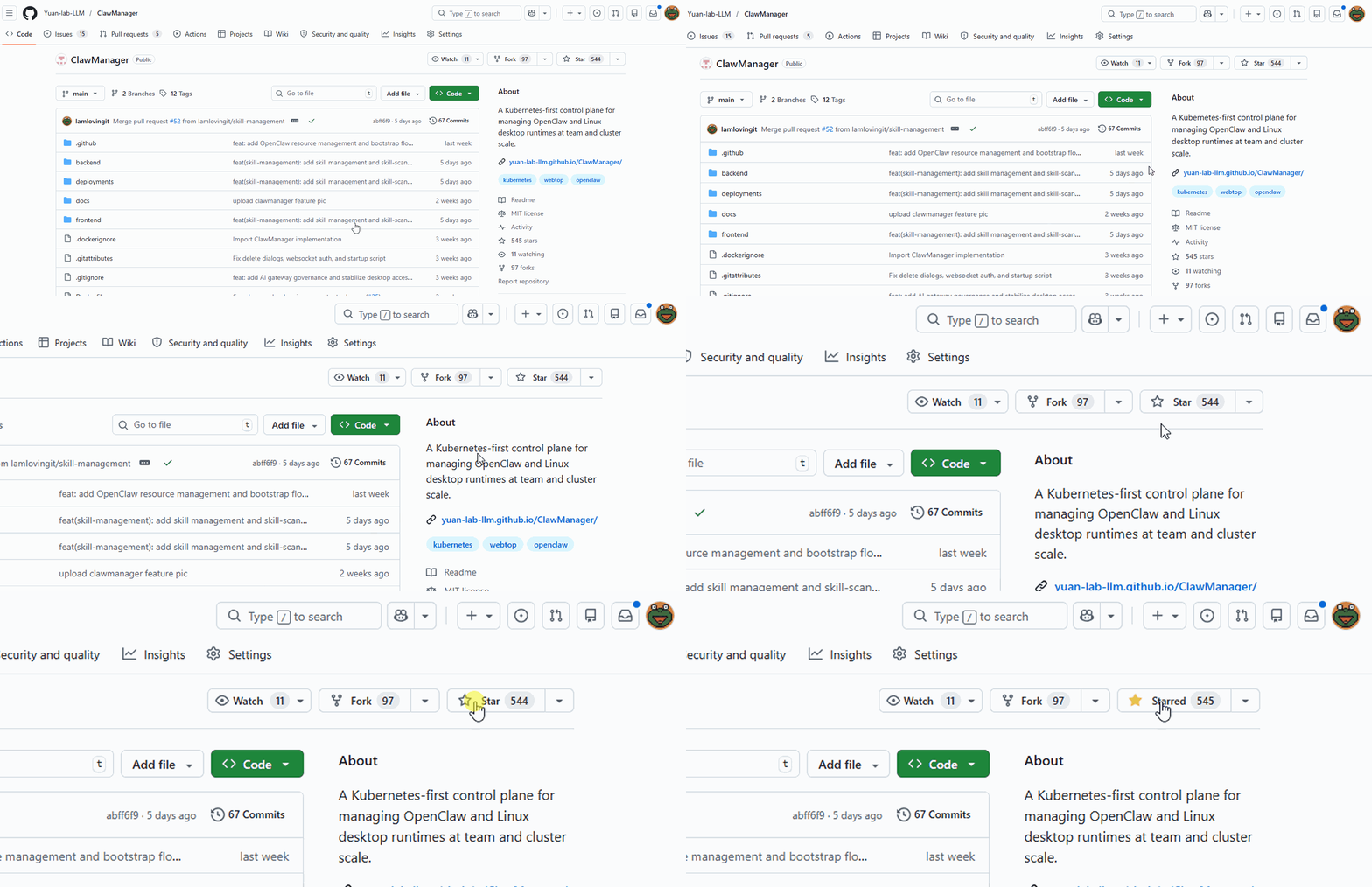
If ClawManager is useful to your team, please star the project to help more users and contributors discover it.
Community
Join the ClawManager open source community on WeChat or Discord for product updates, usage discussion, and contributor collaboration.

Scan to join the WeChat community group |

Discord Scan to join our Discord server |
Product Tour
ClawManager brings AI agent instance operations to Kubernetes and layers three higher-level control planes on top of that runtime foundation. Teams use it to govern AI access, orchestrate runtime behavior through agents, and manage reusable channels and skills with scanning and bundle-based delivery.
It is designed for:
- platform teams running AI agent instances for multiple users
- operators who need runtime visibility, command dispatch, and desired-state control
- builders who want governed AI access and reusable resource injection instead of manual per-instance setup
Team Workspaces
Team Workspaces provide a simplified OpenClaw Lite collaboration flow: choose a role template, create the Team, and describe the goal in the Team chat. The Leader plans the work, coordinates members, collects deliveries, and publishes the final result.
- fixed Leader-mediated collaboration, without per-member runtime or resource-preset setup
- built-in templates for focused delivery, product discovery, and software engineering work
- Team chat for plans, assignments, progress, reviews, deliveries, and final synthesis
- Execution Kanban for the root-task state and current member deliveries
See the Team Workspace Quick Guide for the creation flow, collaboration stages, and result viewing.
Runtime Integrations
ClawManager currently supports the following managed runtimes:

OpenClaw: the default OpenClaw-style workspace runtime used by ClawManager-managed desktop instances
Hermes: a Webtop-based runtime integration with a persistent.hermesworkspace and embedded Hermes agent
Runtime previews:
 OpenClaw

 Hermes

Runtime authors can follow the Hermes Runtime Guide, the Generic Runtime Agent Integration Guide, and the Skill Content MD5 Spec to build compatible agents.
Get Started
ClawManager now separates the Kubernetes distribution from the storage profile. Choose k3s or k8s first, then choose the storage profile that matches the cluster shape:
- k3s single-node HostPath: deployments/k3s/single-node/clawmanager.yaml
- k3s cluster CSI/RWX example: deployments/k3s/cluster/clawmanager.yaml
- Kubernetes single-node HostPath: deployments/k8s/single-node/clawmanager.yaml
- Kubernetes cluster CSI/RWX example: deployments/k8s/cluster/clawmanager.yaml
- Operations-oriented quick start and first login flow: User Guide
- Deployment notes and architecture-level context: Deployment Guide
The cluster profile is validated with Longhorn (longhorn for RWO data and longhorn-rwx for RWX workspaces), but these StorageClass names are examples. You can replace them with any CSI classes that provide the same access modes.
Three Control Planes
AI Gateway
AI Gateway is the governance plane for model access inside ClawManager. It gives managed agent runtimes a unified OpenAI-compatible entry point while adding policy and audit controls on top of upstream providers.
- Unified gateway entry for model traffic
- Secure model routing and policy-aware model selection
- End-to-end audit and trace records
- Built-in cost accounting and usage analysis
- Risk control rules that can block or reroute requests
See the AI Gateway Guide.
Agent Control Plane
Agent Control Plane is the runtime orchestration layer for managed AI agent instances. It turns each instance into a managed runtime that can register, report status, receive commands, and stay aligned with platform-side desired state.
- Agent registration with secure bootstrap and session lifecycle
- Heartbeat-driven runtime status and health reporting
- Desired-state synchronization between the control plane and the instance
- Runtime command dispatch for start, stop, config apply, health checks, and skill operations
- Instance-level visibility into agent status, channels, skills, and command history
See the Agent Control Plane Guide.
Resource Management
Resource Management is the reusable asset layer for AI agent workspaces. It helps teams prepare channels and skills once, organize them into bundles, inject them into instances, and keep security review in the loop.
- Channel management for workspace connectivity and integration templates
- Skill management for reusable packaged capabilities
- Skill Scanner workflows for risk review and scan operations
- Bundle-based resource composition for repeatable workspace setup
- Injection snapshots and runtime-level visibility into what was applied
See the Resource Management Guide and the Security / Skill Scanner Guide.
Product Gallery
The product is designed to feel coherent across administration, workspace access, and AI governance. Instead of treating these as separate tools, ClawManager brings them into one control surface.
Lite Mode Deployment
Lite mode provisions instances through a shared gateway runtime pool. Each workspace runs as an isolated gateway process inside managed runtime Pods, which keeps startup fast and lowers dedicated CPU, memory, storage, and GPU allocation overhead while preserving workspace access, Share Link / Password access, channel and skill injection, and admin visibility.

Pro Mode Deployment
Pro mode provisions a dedicated desktop runtime for each instance, backed by its own Kubernetes Deployment, Service, and PVC. Use it when users need stronger isolation, full desktop resources, runtime events, instance skill management, and the complete desktop management experience.

Team Workspace
The Team workspace page brings the leader desktop, Team chat, member table, and dispatch workflow into one operational view, so users can follow collaboration progress without leaving ClawManager.

Admin Console
The admin console brings together users, quotas, runtime operations, security controls, and platform-level policies in one place. It is the operational center for teams running AI agent infrastructure at scale.

Portal Access
The portal experience gives users a clean entry point into their workspaces, with browser-based access and runtime visibility that stays connected to the control plane instead of exposing infrastructure details directly.

AI Gateway
AI Gateway extends the workspace experience with governed model access, audit trails, cost visibility, and risk-aware routing, making AI usage manageable as part of the platform rather than an isolated integration.

How It Works
- Admins define governance policies and reusable resources.
- Users create or enter managed AI agent workspaces on Kubernetes.
- Team workspaces can provision multiple member runtimes with Redis Team Bus and shared storage configuration.
- Agents connect back to the control plane and report runtime state.
- Channels, skills, and bundles are compiled and applied to instances.
- AI traffic flows through AI Gateway with audit, risk, and cost controls.
Developer Snapshot
ClawManager is built as a Kubernetes-native platform with a React frontend, a Go backend, MySQL for state, and supporting services such as skill-scanner and object storage integrations. The repository is organized around product subsystems rather than a single monolith page, so the best developer experience is to start from the relevant guide and then move into the code.
- Frontend app and admin/user surfaces live under
frontend/ - Backend services, handlers, repositories, and migrations live under
backend/ - Deployment assets live under
deployments/ - Supporting product docs live under
docs/
See the Developer Guide.
Documentation
- User Guide
- Team Workspace Quick Guide
- Deployment Guide
- Admin and User Guide
- Agent Control Plane Guide
- AI Gateway Guide
- Security / Skill Scanner Guide
- Resource Management Guide
- Hermes Runtime Guide
- Generic Runtime Agent Integration Guide
- Skill Content MD5 Spec
- Developer Guide
License
This project is licensed under the MIT License.
Open Source
Issues and pull requests are welcome.