 wehub-resource-sync
9194ef5abd
wehub-resource-sync
9194ef5abd
Docs/Test Workflow / Test docs build (push) Failing after 0s
Check links & references / links-check (push) Failing after 1s
Pytest/Test Workflow / Import Test and Pytest Run (ubuntu-latest, 3.10) (push) Failing after 0s
Pytest/Test Workflow / Import Test and Pytest Run (ubuntu-latest, 3.11) (push) Failing after 0s
PR Conflict Labeler / main (push) Failing after 2s
Pytest/Test Workflow / Import Test and Pytest Run (ubuntu-latest, 3.12) (push) Failing after 2s
Pytest/Test Workflow / Import Test and Pytest Run (ubuntu-latest, 3.13) (push) Failing after 0s
Pytest/Test Workflow / Build this Package (push) Failing after 5s
Pytest/Test Workflow / Import Test and Pytest Run (macos-latest, 3.10) (push) Has been cancelled
Pytest/Test Workflow / Import Test and Pytest Run (macos-latest, 3.11) (push) Has been cancelled
Pytest/Test Workflow / Import Test and Pytest Run (macos-latest, 3.12) (push) Has been cancelled
Pytest/Test Workflow / Import Test and Pytest Run (macos-latest, 3.13) (push) Has been cancelled
Pytest/Test Workflow / Import Test and Pytest Run (windows-latest, 3.10) (push) Has been cancelled
Pytest/Test Workflow / Import Test and Pytest Run (windows-latest, 3.11) (push) Has been cancelled
Pytest/Test Workflow / Import Test and Pytest Run (windows-latest, 3.12) (push) Has been cancelled
Pytest/Test Workflow / Import Test and Pytest Run (windows-latest, 3.13) (push) Has been cancelled
Pytest/Test Workflow / testing-guardian (push) Has been cancelled
507 lines
23 KiB
Markdown
507 lines
23 KiB
Markdown
# Contributing to Supervision 🛠️
|
|
|
|
Thank you for your interest in contributing to Supervision!
|
|
|
|
We are actively improving this library to reduce the amount of work you need to do to solve common computer vision problems.
|
|
|
|
## Code of Conduct
|
|
|
|
Please read and adhere to our [Code of Conduct](https://supervision.roboflow.com/latest/code_of_conduct/). This document outlines the expected behavior for all participants in our project.
|
|
|
|
## Table of Contents
|
|
|
|
- [Contribution Guidelines](#contribution-guidelines)
|
|
- [Contributing Features](#contributing-features)
|
|
- [API Design Principles](#api-design-principles)
|
|
- [How to Contribute Changes](#how-to-contribute-changes)
|
|
- [Installation for Contributors](#installation-for-contributors)
|
|
- [Code Style and Quality](#code-style-and-quality)
|
|
- [Pre-commit tool](#pre-commit-tool)
|
|
- [Docstrings](#docstrings)
|
|
- [Type checking](#type-checking)
|
|
- [Documentation](#documentation)
|
|
- [Cookbooks](#cookbooks)
|
|
- [Tests](#tests)
|
|
- [License](#license)
|
|
|
|
## Contribution Guidelines
|
|
|
|
We welcome contributions to:
|
|
|
|
1. Add a new feature to the library (guidance below).
|
|
2. Improve our documentation and add examples to make it clear how to leverage the supervision library.
|
|
3. Report bugs and issues in the project.
|
|
4. Submit a request for a new feature.
|
|
5. Improve our test coverage.
|
|
|
|
### Contributing Features ✨
|
|
|
|
Supervision is designed to provide generic utilities to solve problems. Thus, we focus on contributions that can have an impact on a wide range of projects.
|
|
|
|
For example, counting objects that cross a line anywhere on an image is a common problem in computer vision, but counting objects that cross a line 75% of the way through is less useful.
|
|
|
|
Before you contribute a new feature, consider submitting an Issue to discuss the feature so the community can weigh in and assist.
|
|
|
|
### API Design Principles
|
|
|
|
Supervision APIs should remain generic, composable, and predictable across model families. Before adding a new integration, annotator option, or data conversion method, check the existing `sv.Detections`, `sv.KeyPoints`, and annotator patterns and follow these principles:
|
|
|
|
1. **Model integrations normalize raw external outputs into existing Supervision containers.** Use `sv.Detections` for detection, segmentation, and other instance-level predictions that include boxes, masks, class ids, confidence scores, or extra per-instance fields. Use `sv.KeyPoints` for standalone keypoint or pose predictions when keypoints exist independently of detection boxes (e.g. pure pose estimation, landmark detection on pre-cropped images). Use `Detections.keypoints` when keypoints are always co-incident with boxes from the same model — the field stores an `(n, K, 2)` or `(n, K, 3)` array where the optional third channel is per-point confidence in `[0, 1]`.
|
|
2. **Do not add a `from_<model>` method when the model already returns a Supervision object.** `from_*` methods are for converting raw outputs from external packages such as Ultralytics, Transformers, Inference, or MediaPipe. If a model's `predict()` method already returns `sv.Detections`, keep that result type and store additional structured payloads in `detections.data` or `detections.metadata` using documented keys.
|
|
3. **Annotators render data; filtering and visibility are container state.** Filtering by confidence, class id, tracker id, geometry, or custom data should happen before annotation through the container slicing APIs, for example `detections[detections.confidence > 0.7]` or `key_points[key_points.confidence > 0.5]`. Per-point presentation state, such as a `KeyPoints.visible` mask, may live on the container and be honored consistently by annotators.
|
|
4. **Annotator constructor arguments should describe visual presentation, not model-quality gates.** Use constructor arguments for color, thickness, opacity, text, position, style, and generic visualization parameters such as sigma levels. Annotators may skip invalid geometry defensively, including missing points, zero-area boxes, non-finite coordinates, or points marked invisible on the container. They should not introduce confidence thresholds or model-specific quality gates as rendering options.
|
|
|
|
## How to Contribute Changes
|
|
|
|
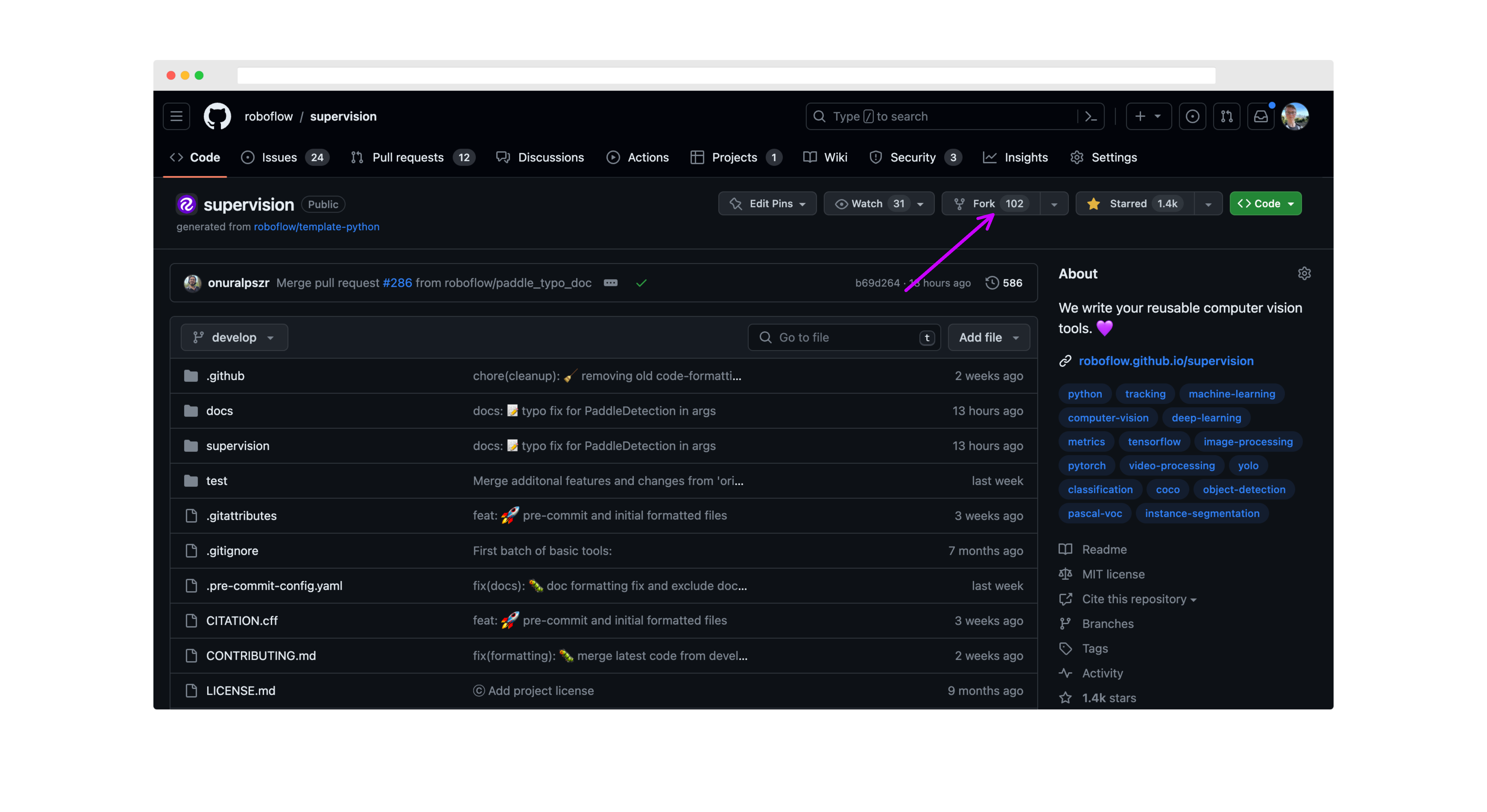
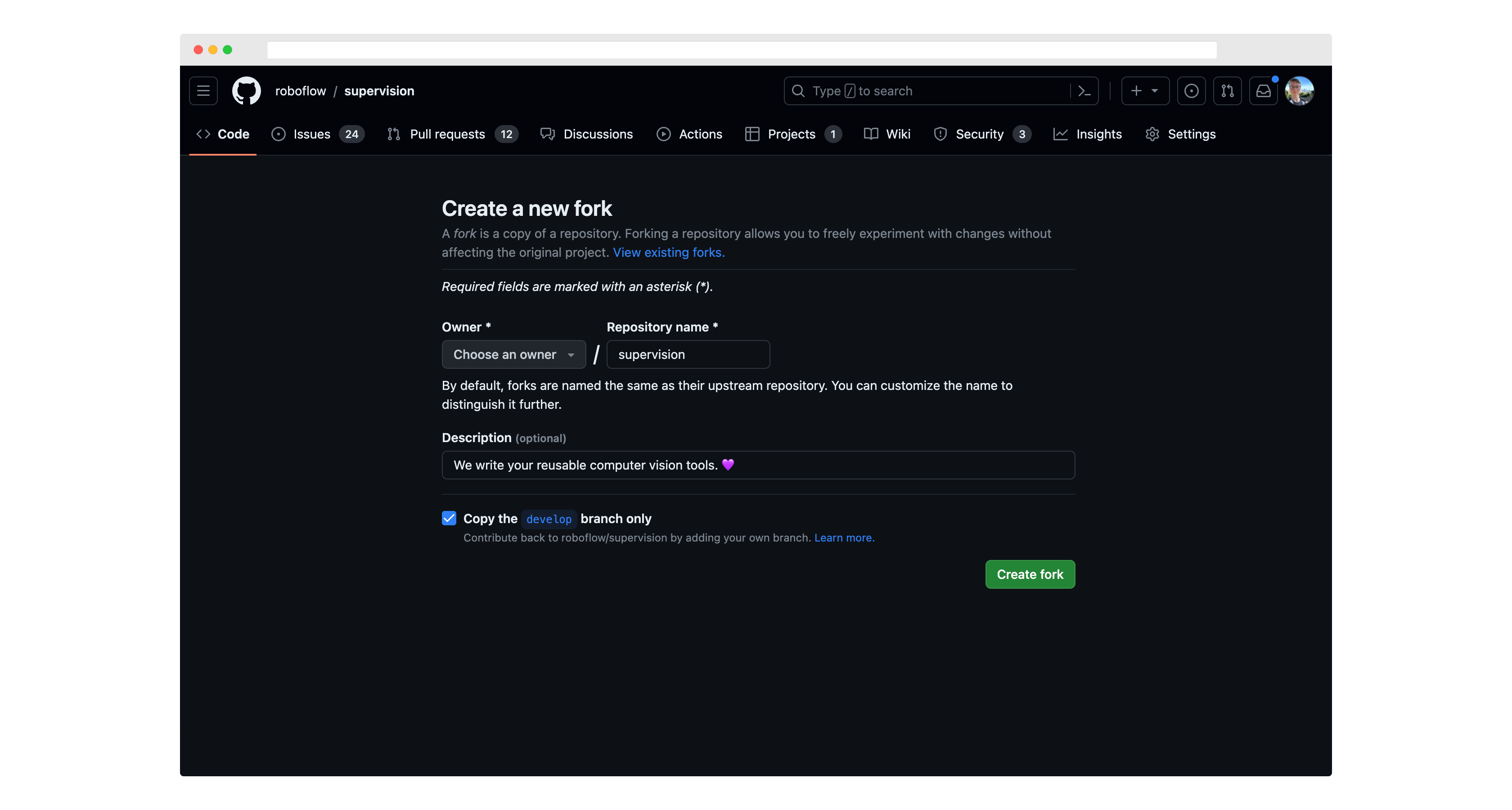
First, fork this repository to your own GitHub account. Click "fork" in the top corner of the `supervision` repository to get started:
|
|
|
|
|
|
|
|
|
|
|
|
Then, run `git clone` to download the project code to your computer.
|
|
|
|
You should also set up `roboflow/supervision` as an "upstream" remote (that is, tell git that the reference Supervision repository was the source of your fork of it):
|
|
|
|
```bash
|
|
git remote add upstream https://github.com/roboflow/supervision.git
|
|
git fetch upstream
|
|
```
|
|
|
|
Move to a new branch using the `git checkout` command:
|
|
|
|
```bash
|
|
git checkout -b <scope>/<your_branch_name> upstream/develop
|
|
```
|
|
|
|
The name you choose for your branch should describe the change you want to make and start with an appropriate prefix:
|
|
|
|
- `feat/`: for new features (e.g., `feat/line-counter`)
|
|
- `fix/`: for bug fixes (e.g., `fix/memory-leak`)
|
|
- `docs/`: for documentation changes (e.g., `docs/update-readme`)
|
|
- `chore/`: for routine tasks, maintenance, or tooling changes (e.g., `chore/update-dependencies`)
|
|
- `test/`: for adding or modifying tests (e.g., `test/add-unit-tests`)
|
|
- `refactor/`: for code refactoring (e.g., `refactor/simplify-algorithm`)
|
|
|
|
Make any changes you want to the project code, then run the following commands to commit your changes:
|
|
|
|
```bash
|
|
git add -A
|
|
git commit -m "feat: add line counter functionality"
|
|
git push -u origin <your_branch_name>
|
|
```
|
|
|
|
Use conventional commit messages to clearly describe your changes. The format is:
|
|
|
|
```
|
|
<type>[optional scope]: <description>
|
|
```
|
|
|
|
Common types include:
|
|
|
|
- `feat`: A new feature
|
|
- `fix`: A bug fix
|
|
- `docs`: Documentation only changes
|
|
- `style`: Changes that do not affect the meaning of the code (white-space, formatting, etc)
|
|
- `refactor`: A code change that neither fixes a bug nor adds a feature
|
|
- `perf`: A code change that improves performance
|
|
- `test`: Adding missing tests or correcting existing tests
|
|
- `chore`: Changes to the build process or auxiliary tools and libraries
|
|
|
|
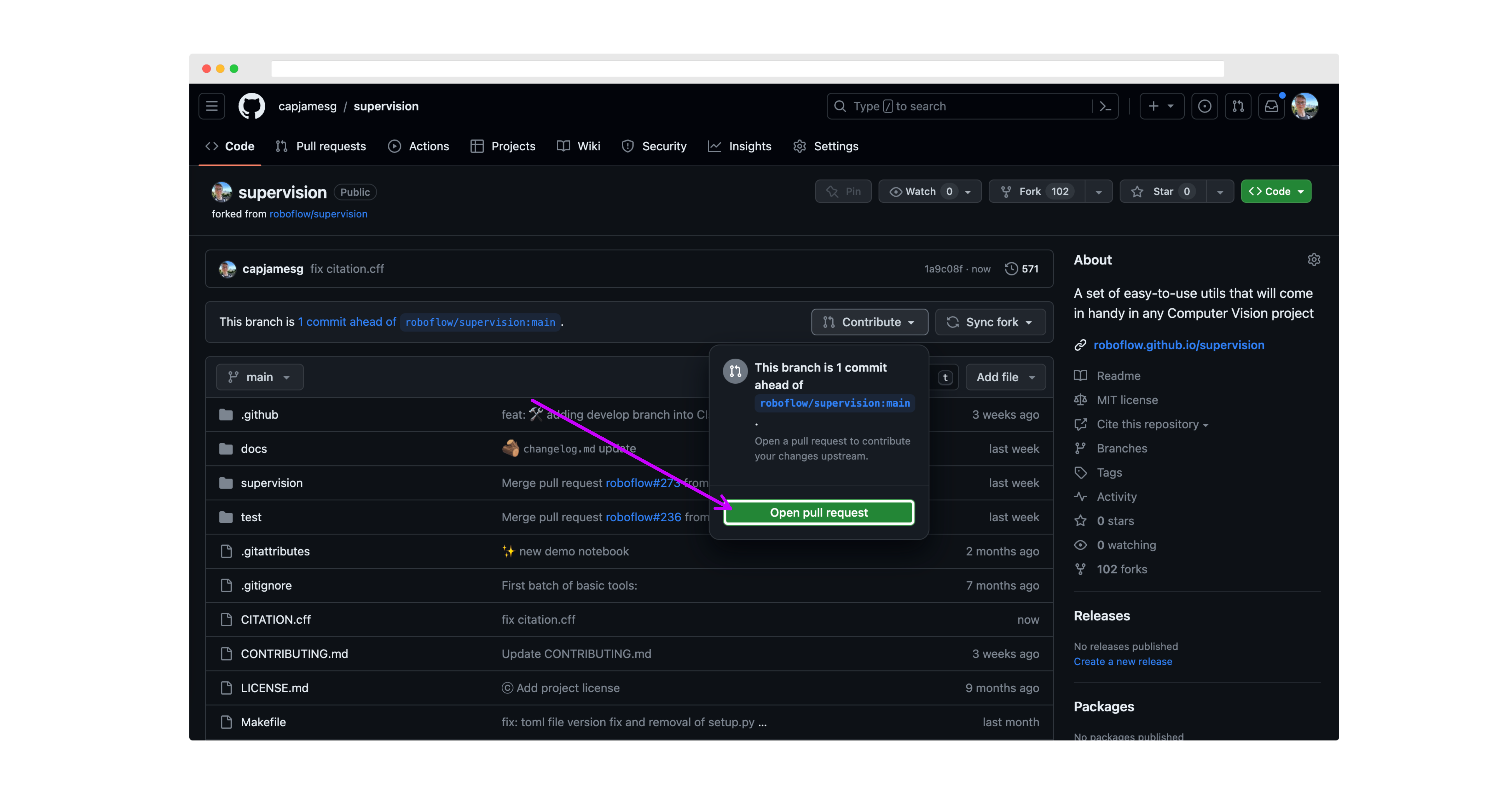
Then, go back to your fork of the `supervision` repository, click "Pull Requests", and click "New Pull Request".
|
|
|
|
|
|
|
|
Make sure the `base` branch is `develop` before submitting your PR.
|
|
|
|
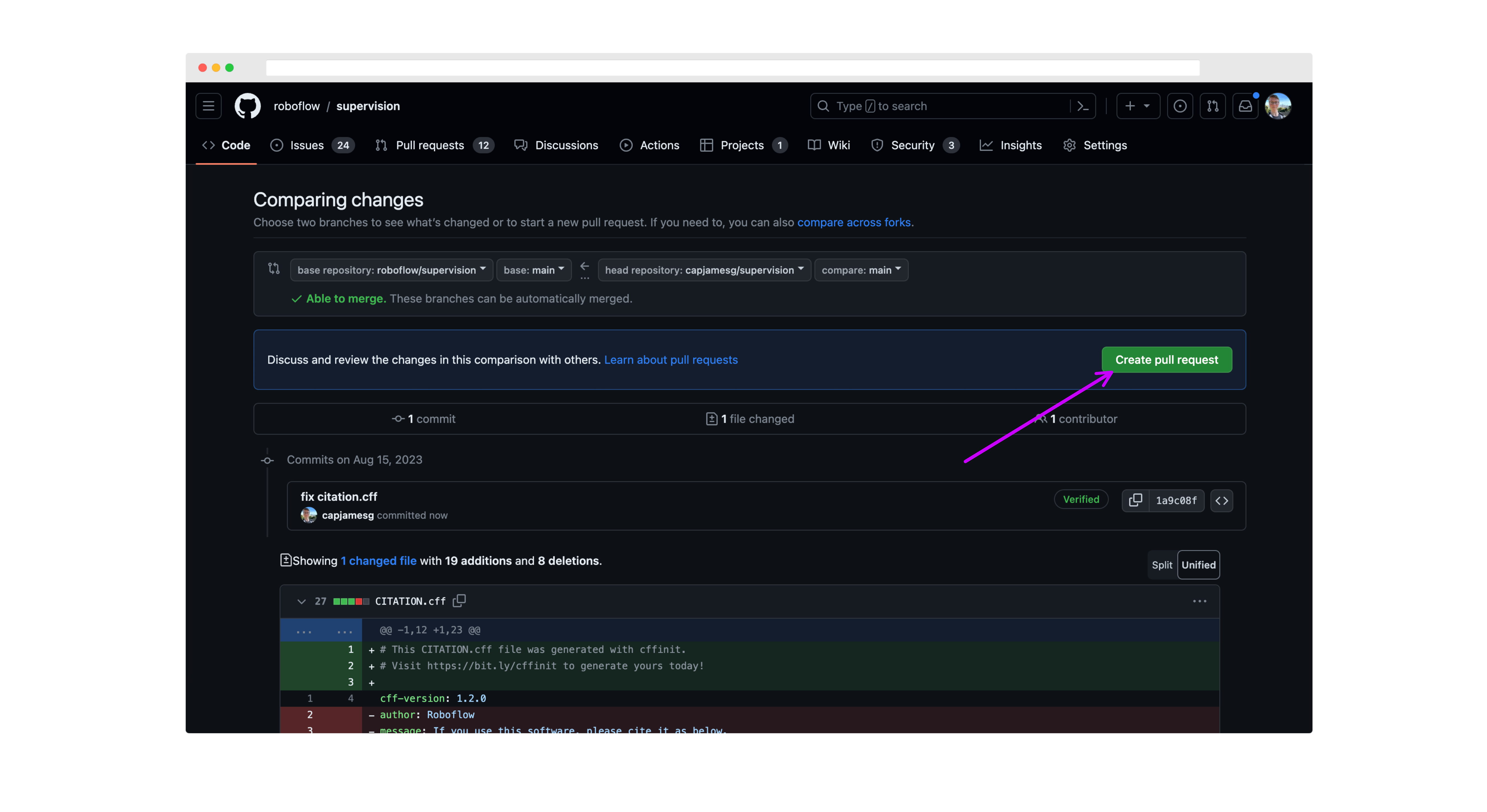
On the next page, review your changes then click "Create pull request":
|
|
|
|
|
|
|
|
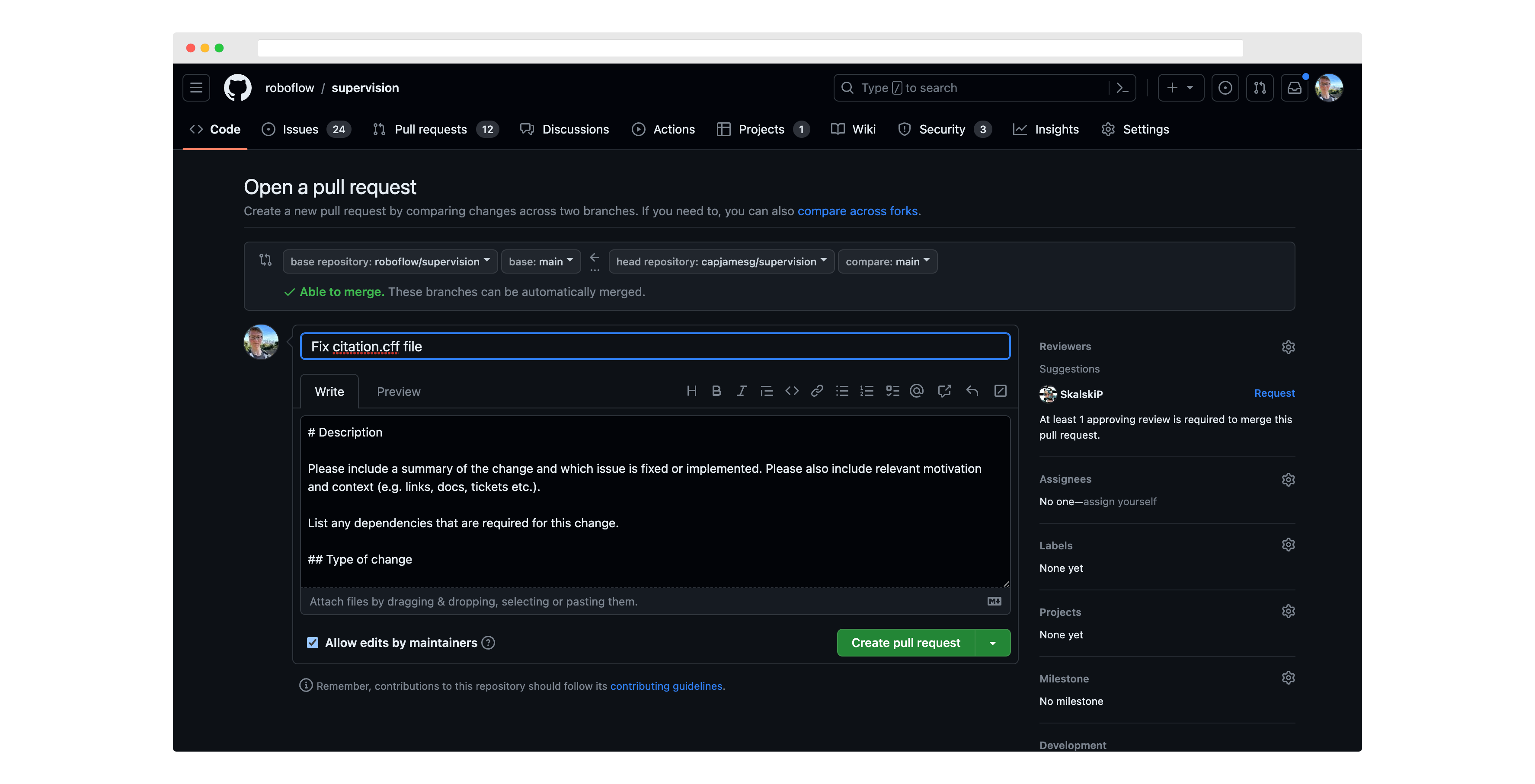
Next, write a description for your pull request, and click "Create pull request" again to submit it for review:
|
|
|
|
|
|
|
|
When creating new functions, please ensure you have the following:
|
|
|
|
1. Docstrings for the function and all parameters.
|
|
2. Unit tests for the function.
|
|
3. Examples in the documentation for the function.
|
|
4. Created an entry in our docs to autogenerate the documentation for the function.
|
|
5. Please share a Google Colab with minimal code to test a new feature or reproduce the issue whenever possible. Please ensure that Google Colab can be accessed without any restrictions.
|
|
|
|
When you submit your Pull Request, you will be asked to sign a Contributor License Agreement (CLA) by the `cla-assistant` GitHub bot. We can only respond to PRs from contributors who have signed the project CLA.
|
|
|
|
All pull requests will be reviewed by the maintainers of the project. We will provide feedback and ask for changes if necessary.
|
|
|
|
PRs must pass all tests and linting requirements before they can be merged.
|
|
|
|
## Installation for Contributors
|
|
|
|
Before starting your work on the project, set up your development environment:
|
|
|
|
1. **Clone your fork of the project:**
|
|
|
|
**Option A: Recommended for most contributors (shallow clone of develop branch):**
|
|
|
|
```bash
|
|
git clone --depth 1 -b develop https://github.com/YOUR_USERNAME/supervision.git
|
|
cd supervision
|
|
```
|
|
|
|
Replace `YOUR_USERNAME` with your GitHub username.
|
|
|
|
> **Note**: Using `--depth 1` creates a shallow clone with minimal history and `-b develop` ensures you start with the development branch. This significantly reduces download size while providing everything needed to contribute.
|
|
|
|
**Option B: Full repository clone (if you need complete history):**
|
|
|
|
```bash
|
|
git clone https://github.com/YOUR_USERNAME/supervision.git
|
|
cd supervision
|
|
git checkout develop
|
|
```
|
|
|
|
2. **Set up the upstream remote:**
|
|
|
|
```bash
|
|
git remote add upstream https://github.com/roboflow/supervision.git
|
|
git fetch upstream
|
|
```
|
|
|
|
3. **Create and activate a virtual environment:**
|
|
|
|
**On Linux/macOS:**
|
|
|
|
```bash
|
|
python3 -m venv .venv
|
|
source .venv/bin/activate
|
|
```
|
|
|
|
**On Windows:**
|
|
|
|
```cmd
|
|
python -m venv .venv
|
|
.venv\Scripts\activate
|
|
```
|
|
|
|
4. **Install `uv`:**
|
|
|
|
Follow the instructions on the [uv installation page](https://docs.astral.sh/uv/getting-started/installation/).
|
|
|
|
5. **Install project dependencies:**
|
|
|
|
```bash
|
|
uv pip install -r pyproject.toml --group dev --group docs --extra metrics
|
|
```
|
|
|
|
6. **Verify the setup:**
|
|
|
|
```bash
|
|
uv run pytest
|
|
```
|
|
|
|
## 🎨 Code Style and Quality
|
|
|
|
### Pre-commit tool
|
|
|
|
This project uses the [pre-commit](https://pre-commit.com/) tool to maintain code quality and consistency. Before submitting a pull request or making any commits, it is important to run the pre-commit tool to ensure that your changes meet the project's guidelines.
|
|
|
|
Furthermore, we have integrated a pre-commit GitHub Action into our workflow. This means that with every pull request opened, the pre-commit checks will be automatically enforced, streamlining the code review process and ensuring that all contributions adhere to our quality standards.
|
|
|
|
To run the pre-commit tool, follow these steps:
|
|
|
|
1. **Install pre-commit** (already included if you followed the installation steps above):
|
|
|
|
```bash
|
|
uv sync --group dev
|
|
```
|
|
|
|
2. **Navigate to the project's root directory** (if not already there).
|
|
|
|
3. **Run pre-commit checks**:
|
|
|
|
```bash
|
|
uv run pre-commit run --all-files
|
|
```
|
|
|
|
This will execute the pre-commit hooks configured for this project. If any issues are found, the pre-commit tool will provide feedback on how to resolve them. Make the necessary changes and re-run the command until all issues are resolved.
|
|
|
|
4. **Install pre-commit as a git hook** (optional but recommended):
|
|
|
|
```bash
|
|
uv run pre-commit install
|
|
```
|
|
|
|
This will automatically run pre-commit checks every time you make a `git commit`.
|
|
|
|
### Docstrings
|
|
|
|
All new functions and classes in `supervision` should include docstrings. This is a prerequisite for any new functions and classes to be added to the library.
|
|
|
|
`supervision` adheres to the [Google Python docstring style](https://google.github.io/styleguide/pyguide.html#383-functions-and-methods). Please refer to the style guide while writing docstrings for your contribution.
|
|
|
|
Every docstring should include a usage example. When the example only uses `supervision`, NumPy, and the standard library — no optional extras, no external files or network access — strongly prefer `>>>` doctest format so it is automatically verified by the test suite. See [Doctests](#doctests) below for syntax guidance and for when fenced ```` ```python ```` blocks are appropriate instead.
|
|
|
|
### Type checking
|
|
|
|
Type hints are required on all new code. mypy is enforced by the pre-commit hook configured in `.pre-commit-config.yaml` — your PR will fail CI if mypy reports errors.
|
|
|
|
### Readability
|
|
|
|
Avoid multi-branch conditional expressions inside function or constructor arguments. If an argument needs more than a simple `a if condition else b`, assign it to a named local variable before the call.
|
|
|
|
### Performance
|
|
|
|
- Avoid unnecessary copies of NumPy arrays.
|
|
- Prefer vectorized operations over Python loops in hot paths.
|
|
- Lazy-import heavy framework dependencies (`torch`, `transformers`, `ultralytics`) inside the function that needs them — never at module top level.
|
|
|
|
### Deprecation policy
|
|
|
|
**Minimum window**: deprecated APIs must remain for at least **3 minor releases** before removal. Example: deprecated in `0.29.0` → removed in `0.32.0`.
|
|
|
|
Use the appropriate mechanism depending on what is being deprecated:
|
|
|
|
- **Module-level alias**: `supervision.utils.internal.warn_deprecated` in the deprecated module's `__init__.py`
|
|
- **Renamed parameter**: `supervision.utils.internal.deprecated_parameter` decorator
|
|
- **Public function, method, or class**: `@deprecated` from `pydeprecate`
|
|
|
|
Always specify both the deprecation version and the planned removal version in the message or decorator arguments.
|
|
|
|
### Deprecated module aliases
|
|
|
|
`supervision.keypoint` is deprecated since `0.27.0` and will be removed in `0.30.0`. Always import from `supervision.key_points`:
|
|
|
|
```python
|
|
from supervision.key_points import KeyPoints # correct
|
|
```
|
|
|
|
## 📝 Documentation
|
|
|
|
The `supervision` documentation is stored in a folder called `docs`. The project documentation is built using `mkdocs`.
|
|
|
|
To run the documentation locally:
|
|
|
|
1. **Install documentation dependencies** (if not already installed):
|
|
|
|
```bash
|
|
uv sync --group docs
|
|
```
|
|
|
|
2. **Start the documentation server**:
|
|
|
|
```bash
|
|
uv run mkdocs serve
|
|
```
|
|
|
|
3. **Access the documentation** at `http://127.0.0.1:8000` in your browser.
|
|
|
|
You can learn more about mkdocs on the [mkdocs website](https://www.mkdocs.org/).
|
|
|
|
## 🧑🍳 Cookbooks
|
|
|
|
We are always looking for new examples and cookbooks to add to the `supervision` documentation. If you have a use case that you think would be helpful to others, please submit a PR with your example. Here are some guidelines for submitting a new example:
|
|
|
|
- Create a new notebook in the [`docs/notebooks`](https://github.com/roboflow/supervision/tree/develop/docs/notebooks) folder.
|
|
- Add a link to the new notebook in [`docs/theme/cookbooks.html`](https://github.com/roboflow/supervision/blob/develop/docs/theme/cookbooks.html). Make sure to add the path to the new notebook, as well as a title, labels, author and supervision version.
|
|
- Use the [Count Objects Crossing the Line](https://supervision.roboflow.com/develop/notebooks/count-objects-crossing-the-line/) example as a template for your new example.
|
|
- Pin the version of `supervision` you are using in the notebook.
|
|
- Place an appropriate "Open in Colab" button at the top of the notebook. You can find an example of such a button in the aforementioned `Count Objects Crossing the Line` cookbook.
|
|
- **Notebook should be self-contained**. If you rely on external data (videos, images, etc.) or libraries, include download and installation commands in the notebook.
|
|
- Annotate the code with appropriate comments, including links to the documentation describing each of the tools you have used.
|
|
|
|
## 🧪 Tests
|
|
|
|
[`pytest`](https://docs.pytest.org/en/7.1.x/) is used to run our tests.
|
|
|
|
To run tests:
|
|
|
|
```bash
|
|
uv run pytest
|
|
```
|
|
|
|
To run tests with coverage:
|
|
|
|
```bash
|
|
uv run pytest --cov=supervision
|
|
```
|
|
|
|
### Test Structure
|
|
|
|
Follow **Arrange-Act-Assert (AAA)**: one setup block, one action, one assertion group per test. Never put two independent actions in the same test.
|
|
|
|
**Class grouping:** Group related tests into a class. The class name carries the unit under test; method names describe the expected outcome only — not the mechanism.
|
|
|
|
```python
|
|
class TestDetectionsWithNms:
|
|
def test_keeps_highest_confidence_detection(self): ...
|
|
def test_suppresses_lower_score_when_overlap_exceeds_threshold(self): ...
|
|
def test_raises_when_confidence_missing(self): ...
|
|
```
|
|
|
|
**Parametrize aggressively:** Three or more structurally identical tests should become a single `@pytest.mark.parametrize` case. Use `pytest.param(..., id="slug")` per case — not `ids=[...]` on the decorator — so the ID stays co-located with its arguments and survives reordering.
|
|
|
|
```python
|
|
@pytest.mark.parametrize(
|
|
("overlap_metric", "expected_keep"),
|
|
[
|
|
pytest.param(OverlapMetric.IOU, [True, True], id="iou-keeps-both"),
|
|
pytest.param(OverlapMetric.IOS, [True, False], id="ios-suppresses-small"),
|
|
],
|
|
)
|
|
def test_overlap_metric_determines_suppression(
|
|
overlap_metric: OverlapMetric, expected_keep: list[bool]
|
|
) -> None:
|
|
"""Small box inside large: IOU keeps both; IOS suppresses small."""
|
|
...
|
|
```
|
|
|
|
**Docstrings:** Every test function/method requires at minimum a one-line docstring (within the project line length configured in `pyproject.toml`). Describe the scenario, not the implementation.
|
|
|
|
### Doctests
|
|
|
|
**Guidance:** when an example uses only `supervision`, NumPy, and the standard library — no optional extras (e.g. no `--extra metrics` packages), no external files, no network, no devices — prefer `>>>` doctest format so it is automatically verified by the test suite. Fenced ```` ```python ```` blocks are appropriate when the example cannot reasonably be executed (e.g. loading a third-party model, reading a video file) or when the primary purpose is demonstrating error/exception behaviour rather than return values.
|
|
|
|
Doctests run automatically as part of the test suite via `--doctest-modules` in `pyproject.toml`. The `ELLIPSIS` and `NORMALIZE_WHITESPACE` flags are enabled globally, so `...` matches any output fragment and minor whitespace differences are ignored.
|
|
|
|
```bash
|
|
uv run pytest --doctest-modules src/
|
|
```
|
|
|
|
**Writing a doctest**
|
|
|
|
Use the `Example:` section of a Google-style docstring. Prefix each input line with `>>>` and each continuation line with `...`. Place expected output immediately after the last input line with no blank line between them.
|
|
|
|
```python
|
|
def clip_boxes(xyxy: np.ndarray, resolution_wh: tuple) -> np.ndarray:
|
|
"""Clip bounding boxes to frame boundaries.
|
|
|
|
Args:
|
|
xyxy: Box coordinates as (N, 4) float array.
|
|
resolution_wh: Frame size as (width, height).
|
|
|
|
Returns:
|
|
Clipped boxes as (N, 4) float array.
|
|
|
|
Example:
|
|
>>> import numpy as np
|
|
>>> import supervision as sv
|
|
>>> boxes = np.array([[-10, -5, 120, 80]], dtype=np.float32)
|
|
>>> sv.clip_boxes(boxes, resolution_wh=(100, 60))
|
|
array([[ 0., 0., 100., 60.]], dtype=float32)
|
|
"""
|
|
```
|
|
|
|
### Key rules
|
|
|
|
- **Single-line expression** — write the repr as expected output: `>>> len(result)` → `1`
|
|
- **Multi-line statement** — use `...` continuation: `>>> arr = np.array([` / `... [1, 2],` / `... ])`
|
|
- **Print output** — write the printed string as expected output (no quotes).
|
|
- **`None` return** — no output line needed (suppress with assignment or `_ =`).
|
|
- **Large/variable arrays** — use `ELLIPSIS`: `array([...])` matches any content.
|
|
- **`# doctest: +SKIP`** — use only as a last resort for genuinely non-runnable lines (e.g. a GPU-only call inside an otherwise runnable example). Prefer splitting the example into two blocks instead.
|
|
|
|
Fenced ```` ```python ```` blocks remain appropriate for:
|
|
|
|
- Examples that import optional extras (`supervision[metrics]`, `torch`, `ultralytics`).
|
|
- Examples that read files, capture video, or require a running service.
|
|
- Illustrative pseudocode that is intentionally incomplete.
|
|
|
|
## 🔍 PR Review Guidelines
|
|
|
|
These guidelines help reviewers provide consistent, actionable feedback efficiently. Your goals: validate completeness, identify risks, provide actionable feedback, and highlight quality gaps.
|
|
|
|
### Overall Recommendation
|
|
|
|
Start with a clear recommendation using these levels:
|
|
|
|
- 🟢 **Approve** — Ready to merge
|
|
- 🟡 **Minor Suggestions** — Improvements recommended but not blocking
|
|
- 🟠 **Request Changes** — Must address issues before merge
|
|
- 🔴 **Block** — Critical issues require major rework
|
|
|
|
Example: `🟠 Request Changes — Missing unit tests for PolygonMerger and no mkdocs entry.`
|
|
|
|
### PR Completeness
|
|
|
|
Verify requirements are met (✅ Complete / ⚠️ Incomplete / ❌ Missing / 🔵 N/A):
|
|
|
|
- [ ] Clear description of what changed and why
|
|
- [ ] Tests added/updated for new functionality or bug fixes
|
|
- [ ] Docstrings follow [Google-style](https://google.github.io/styleguide/pyguide.html#383-functions-and-methods)
|
|
- [ ] Docs entry added to mkdocs (new functions/classes only)
|
|
- [ ] Google Colab provided (if demonstrating feature/fix)
|
|
- [ ] Screenshots/videos included (visual changes only)
|
|
|
|
Call out missing items explicitly in your review.
|
|
|
|
### Quality Scores
|
|
|
|
Use **n/5 scoring** with inline code comments for specifics:
|
|
|
|
**Code Quality (n/5):**
|
|
|
|
- 5/5 🟢 Excellent — 4/5 🟢 Good — 3/5 🟡 Acceptable — 2/5 🟠 Needs Work — 1/5 🔴 Poor
|
|
- Check: correctness (edge cases, None checks, bounds), Python best practices (idiomatic patterns, error handling, type hints), project conventions (docstrings, linting, import order, PEP 8 naming)
|
|
|
|
**Testing (n/5):**
|
|
|
|
- 5/5 🟢 Comprehensive — 4/5 🟢 Good — 3/5 🟡 Adequate — 2/5 🟠 Insufficient — 1/5 🔴 Missing
|
|
- Verify: unit tests for new code, edge cases covered, specific assertions, realistic scenarios, clear test names
|
|
|
|
**Documentation (n/5):**
|
|
|
|
- 5/5 🟢 Excellent — 4/5 🟢 Good — 3/5 🟡 Adequate — 2/5 🟠 Insufficient — 1/5 🔴 Missing
|
|
- Confirm: docstrings for public functions/classes, parameters/returns/exceptions documented, usage examples, mkdocs integration, changelog entry for user-facing changes
|
|
|
|
### Risk Assessment
|
|
|
|
Flag risks with severity (5/5 🔴 Critical — 4/5 🟠 High — 3/5 🟡 Medium — 2/5 🟢 Low — 1/5 🟢 Negligible):
|
|
|
|
**Common risk categories:**
|
|
|
|
1. **Breaking changes** — API changes, removed features, behavior modifications (must include migration guide)
|
|
2. **Performance** — Inefficient algorithms, memory-intensive operations, bottlenecks
|
|
3. **Compatibility** — New Python/dependency requirements, platform-specific code
|
|
4. **Security** — Unvalidated input, code execution risks, data exposure
|
|
|
|
### Review Summary Template
|
|
|
|
```markdown
|
|
## Review Summary
|
|
|
|
**Recommendation:** [emoji] [Status] — [justification]
|
|
|
|
**PR Completeness:**
|
|
- ✅ Complete: [items]
|
|
- ❌ Missing: [gaps]
|
|
|
|
**Quality Scores:**
|
|
- Code: n/5 [emoji] — [reason]
|
|
- Testing: n/5 [emoji] — [reason]
|
|
- Documentation: n/5 [emoji] — [reason]
|
|
|
|
**Risk Level:** n/5 [emoji] — [description]
|
|
|
|
**Critical Issues (Must Fix):**
|
|
1. [Issue] — See comment on `file.py`
|
|
|
|
**Suggestions (Optional):**
|
|
1. [Improvement] — See suggestion on `file.py`
|
|
|
|
**Next Steps:**
|
|
1. [Action item]
|
|
```
|
|
|
|
### Review Best Practices
|
|
|
|
**DO:** Use inline GitHub comments with suggestions, explain *why* (not just *what*), distinguish blocking vs. nice-to-have, acknowledge good work, run linter if needed (`uv run pre-commit run --all-files`)
|
|
|
|
**DON'T:** Mention line numbers in summary (use inline comments), give vague feedback, nitpick style (defer to tools), assume knowledge of conventions, block on minor issues
|
|
|
|
**Tone:** Be respectful, specific, pragmatic, and consistent. Focus on actionable feedback that moves PRs toward merge.
|
|
|
|
## 📄 License
|
|
|
|
By contributing, you agree that your contributions will be licensed under an [MIT license](../LICENSE.md).
|