 wehub-resource-sync
16031aae96
wehub-resource-sync
16031aae96
CPU tests Workflow / Testing (ubuntu-latest, 3.12) (push) Failing after 1s
CPU tests Workflow / Testing (ubuntu-latest, 3.13) (push) Failing after 0s
Mypy Type Check / Type Check (push) Failing after 0s
Docs/Test WorkFlow / Test docs build (push) Failing after 1s
PR Conflict Labeler / labeling (push) Failing after 1s
Dependency resolution / Resolve [tflite] extra — Python 3.12 (push) Failing after 0s
Smoke Tests / try-all-models (ubuntu-latest, 3.10) (push) Failing after 0s
Smoke Tests / try-all-models (ubuntu-latest, 3.13) (push) Failing after 1s
CPU tests Workflow / build-pkg (push) Failing after 1s
CPU tests Workflow / Testing (ubuntu-latest, 3.10) (push) Failing after 0s
CPU tests Workflow / Testing (ubuntu-latest, 3.11) (push) Failing after 0s
Smoke Tests / try-all-models (macos-latest, 3.10) (push) Has been cancelled
Smoke Tests / try-all-models (macos-latest, 3.13) (push) Has been cancelled
Smoke Tests / try-all-models (windows-latest, 3.10) (push) Has been cancelled
Smoke Tests / try-all-models (windows-latest, 3.13) (push) Has been cancelled
CPU tests Workflow / Testing (macos-latest, 3.10) (push) Has been cancelled
CPU tests Workflow / Testing (macos-latest, 3.13) (push) Has been cancelled
CPU tests Workflow / Testing (windows-latest, 3.10) (push) Has been cancelled
CPU tests Workflow / Testing (windows-latest, 3.13) (push) Has been cancelled
CPU tests Workflow / testing-guardian (push) Has been cancelled
GPU tests Workflow / Testing (push) Has been cancelled
197 lines
12 KiB
Markdown
197 lines
12 KiB
Markdown
---
|
||
description: RF-DETR is a real-time transformer for object detection, instance segmentation, and keypoint detection (preview) by Roboflow. DINOv2 backbone, SOTA on COCO (60.1 AP50:95). Apache 2.0.
|
||
hide:
|
||
- navigation
|
||
---
|
||
|
||
# RF-DETR: Real-Time SOTA Object Detection, Instance Segmentation, and Keypoint Detection
|
||
|
||
RF-DETR is a real-time transformer architecture for object detection, instance segmentation, and keypoint detection (preview) developed by Roboflow. Built on a DINOv2 vision transformer backbone, RF-DETR achieves state-of-the-art accuracy–latency trade-offs: RF-DETR-L reaches 56.5 AP50:95 on COCO at 6.8 ms (NVIDIA T4, TensorRT FP16), and RF-DETR-2XL achieves 60.1 AP50:95 — the first real-time model to exceed 60 AP on COCO. Accepted at [ICLR 2026](https://arxiv.org/abs/2511.09554).
|
||
|
||
RF-DETR uses a DINOv2 vision transformer backbone and supports object detection, instance segmentation, and keypoint detection (preview) in a single, consistent API. Core models (Nano through Large) and all code are released under the Apache 2.0 license; XL and 2XLarge detection models require `rfdetr[plus]` and are provided under PML 1.0.
|
||
|
||
Developed by Isaac Robinson, Peter Robicheaux, Matvei Popov, Deva Ramanan (CMU), and Neehar Peri (CMU) at [Roboflow](https://roboflow.com). If you use RF-DETR in your research, please cite:
|
||
|
||
```bibtex
|
||
@inproceedings{robinson2026rfdetr,
|
||
title = {RF-DETR: Real-Time Detection Transformer},
|
||
author = {Robinson, Isaac and Robicheaux, Peter and Popov, Matvei and Ramanan, Deva and Peri, Neehar},
|
||
booktitle = {International Conference on Learning Representations (ICLR)},
|
||
year = {2026},
|
||
url = {https://arxiv.org/abs/2511.09554}
|
||
}
|
||
```
|
||
|
||
## Install
|
||
|
||
You can install and use `rfdetr` in a [**Python>=3.10**](https://www.python.org/) environment. For detailed installation instructions, including installing from source, and setting up a local development environment, check out our [install](getting-started/install.md) page.
|
||
|
||
!!! example "Installation"
|
||
|
||
<a href="https://badge.fury.io/py/rfdetr"><img alt="version" src="https://badge.fury.io/py/rfdetr.svg" width="125" height="20" /></a>
|
||
<a href="https://badge.fury.io/py/rfdetr"><img alt="python-version" src="https://img.shields.io/pypi/pyversions/rfdetr" width="198" height="20" /></a>
|
||
<a href="https://github.com/roboflow/rf-detr/blob/main/LICENSE"><img alt="license" src="https://img.shields.io/pypi/l/rfdetr" width="164" height="20" /></a>
|
||
<a href="https://pypistats.org/packages/rfdetr"><img alt="downloads" src="https://img.shields.io/pypi/dm/rfdetr" width="258" height="20" /></a>
|
||
|
||
=== "pip"
|
||
|
||
```bash
|
||
pip install rfdetr
|
||
```
|
||
|
||
=== "uv"
|
||
|
||
```bash
|
||
uv pip install rfdetr
|
||
```
|
||
|
||
For uv projects:
|
||
|
||
```bash
|
||
uv add rfdetr
|
||
```
|
||
|
||
## Quickstart
|
||
|
||
<div class="grid cards" markdown>
|
||
|
||
- **Run Detection Models**
|
||
|
||
---
|
||
|
||
Load and run pre-trained RF-DETR detection models.
|
||
|
||
[:octicons-arrow-right-24: Tutorial](learn/run/detection.md)
|
||
|
||
- **Run Segmentation Models**
|
||
|
||
---
|
||
|
||
Load and run pre-trained RF-DETR-Seg segmentation models.
|
||
|
||
[:octicons-arrow-right-24: Tutorial](learn/run/segmentation.md)
|
||
|
||
- **Train Models**
|
||
|
||
---
|
||
|
||
Learn how to fine-tune RF-DETR models for detection and segmentation.
|
||
|
||
[:octicons-arrow-right-24: Tutorial](learn/train/index.md)
|
||
|
||
</div>
|
||
|
||
## Tutorials
|
||
|
||
<div class="grid cards" markdown>
|
||
|
||
- **Train RF-DETR on a Custom Dataset. Video**
|
||
|
||
---
|
||
|
||
{ width="1280" height="720" loading="lazy" }
|
||
|
||
End to end walkthrough of training RF-DETR on a custom dataset.
|
||
|
||
[:octicons-arrow-right-24: Watch the video](https://www.youtube.com/watch?v=-OvpdLAElFA)
|
||
|
||
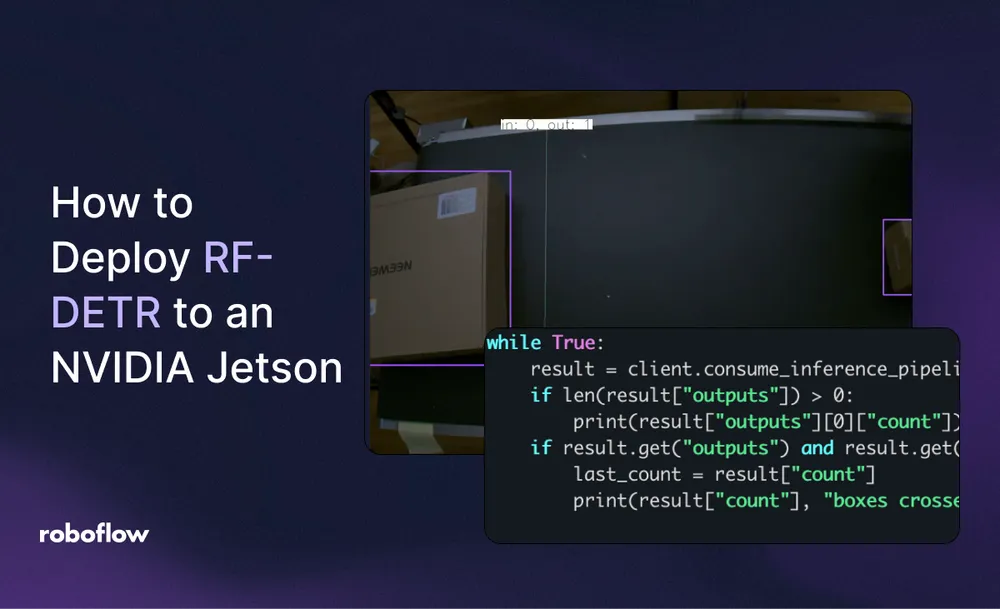
- **Deploy RF-DETR to NVIDIA Jetson. Article**
|
||
|
||
---
|
||
|
||
{ width="1000" height="563" loading="lazy" }
|
||
|
||
Instructions for deploying RF-DETR on NVIDIA Jetson with Roboflow Inference.
|
||
|
||
[:octicons-arrow-right-24: Read the tutorial](https://blog.roboflow.com/how-to-deploy-rf-detr-to-an-nvidia-jetson/)
|
||
|
||
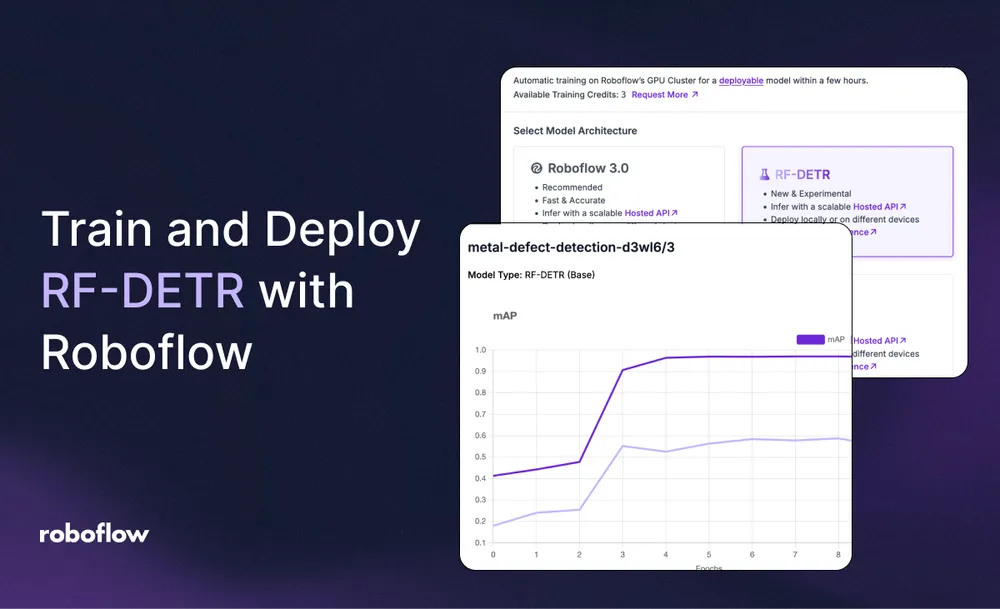
- **Train and Deploy RF-DETR with Roboflow**
|
||
|
||
---
|
||
|
||
{ width="1000" height="563" loading="lazy" }
|
||
|
||
Cloud training and hardware deployment workflow using Roboflow.
|
||
|
||
[:octicons-arrow-right-24: Read the tutorial](https://blog.roboflow.com/train-and-deploy-rf-detr-models-with-roboflow/)
|
||
|
||
</div>
|
||
|
||
## Benchmarks
|
||
|
||
RF-DETR achieves the best accuracy–latency trade-off among real-time object detection and instance segmentation models. It also provides keypoint detection (preview) on COCO person keypoints. For detailed benchmark tables and methodology, check out our [benchmarks](learn/benchmarks.md) page.
|
||
|
||
### Detection
|
||
|
||
<img alt="Pareto front — detection accuracy vs latency: RF-DETR-2XL achieves 78.5 COCO AP50 (60.1 AP50:95) at 17.2 ms; RF-DETR-L achieves 75.1 AP50 at 6.8 ms, outperforming YOLO11x at comparable latency" src="https://storage.googleapis.com/com-roboflow-marketing/rf-detr/rf_detr_1-4_latency_accuracy_object_detection.png" width="840" height="630" style="max-width: 840px; height: auto;" />
|
||
|
||
| Architecture | COCO AP<sub>50</sub> | COCO AP<sub>50:95</sub> | RF100VL AP<sub>50</sub> | RF100VL AP<sub>50:95</sub> | Latency (ms) | Params (M) | Resolution |
|
||
| ------------ | -------------------- | ----------------------- | ----------------------- | -------------------------- | ------------ | ---------- | ---------- |
|
||
| RF-DETR-N | 67.6 | 48.4 | 85.0 | 57.7 | 2.3 | 30.5 | 384×384 |
|
||
| RF-DETR-S | 72.1 | 53.0 | 86.7 | 60.2 | 3.5 | 32.1 | 512×512 |
|
||
| RF-DETR-M | 73.6 | 54.7 | 87.4 | 61.2 | 4.4 | 33.7 | 576×576 |
|
||
| RF-DETR-L | 75.1 | 56.5 | 88.2 | 62.2 | 6.8 | 33.9 | 704×704 |
|
||
| RF-DETR-XL | 77.4 | 58.6 | 88.5 | 62.9 | 11.5 | 126.4 | 700×700 |
|
||
| RF-DETR-2XL | 78.5 | 60.1 | 89.0 | 63.2 | 17.2 | 126.9 | 880×880 |
|
||
|
||
### Segmentation
|
||
|
||
<img alt="Pareto front — segmentation accuracy vs latency: RF-DETR-Seg-2XL achieves 73.1 COCO AP50 (49.9 AP50:95) at 21.8 ms; RF-DETR-Seg-L achieves 70.5 AP50 at 8.8 ms" src="https://storage.googleapis.com/com-roboflow-marketing/rf-detr/rf_detr_1-4_latency_accuracy_instance_segmentation.png" width="840" height="630" style="max-width: 840px; height: auto;" />
|
||
|
||
| Architecture | COCO AP<sub>50</sub> | COCO AP<sub>50:95</sub> | Latency (ms) | Params (M) | Resolution |
|
||
| --------------- | -------------------- | ----------------------- | ------------ | ---------- | ---------- |
|
||
| RF-DETR-Seg-N | 63.0 | 40.3 | 3.4 | 33.6 | 312×312 |
|
||
| RF-DETR-Seg-S | 66.2 | 43.1 | 4.4 | 33.7 | 384×384 |
|
||
| RF-DETR-Seg-M | 68.4 | 45.3 | 5.9 | 35.7 | 432×432 |
|
||
| RF-DETR-Seg-L | 70.5 | 47.1 | 8.8 | 36.2 | 504×504 |
|
||
| RF-DETR-Seg-XL | 72.2 | 48.8 | 13.5 | 38.1 | 624×624 |
|
||
| RF-DETR-Seg-2XL | 73.1 | 49.9 | 21.8 | 38.6 | 768×768 |
|
||
|
||
### Keypoints
|
||
|
||
<img alt="RF-DETR Keypoint mAP vs latency chart comparing against YOLO26-pose and YOLO11-pose on MS COCO" src="assets/keypoints/kp-map-latency.png" width="840" height="630" style="max-width: 840px; height: auto;" />
|
||
|
||
| Architecture | COCO AP<sub>50:95</sub> | Latency (ms) | Params (M) | Resolution |
|
||
| -------------------------- | ----------------------- | ------------ | ---------- | ---------- |
|
||
| RF-DETR Keypoint (Preview) | 71.8 | 9.7 | 126.4 | 576×576 |
|
||
|
||
> Keypoint benchmarks report AP<sub>50:95</sub> (OKS-based); this is the standard COCO keypoint comparison metric.
|
||
> For the full competitor comparison (YOLO11-pose, YOLO26-pose), see the [Benchmarks](learn/benchmarks.md#keypoints) page.
|
||
|
||
## Frequently Asked Questions
|
||
|
||
**What is RF-DETR?**
|
||
RF-DETR (Roboflow Detection Transformer) is a real-time object detection and instance segmentation model from Roboflow, accepted at ICLR 2026. It uses a DINOv2 vision transformer backbone and achieves state-of-the-art accuracy–latency trade-offs on COCO (60.1 AP50:95 for RF-DETR-2XL) and RF100-VL.
|
||
|
||
**How does RF-DETR compare to YOLOv11?**
|
||
RF-DETR-L achieves 56.5 AP50:95 on COCO at 6.8 ms latency on an NVIDIA T4, outperforming YOLOv11x (50.9 AP) at lower latency. The DINOv2 backbone gives RF-DETR stronger performance on domain-shift benchmarks such as RF100-VL.
|
||
|
||
**What GPU is required to train RF-DETR?**
|
||
A CUDA-capable GPU with at least 8 GB VRAM (e.g., NVIDIA RTX 3060, T4, A10) is recommended for fine-tuning. Smaller models (RF-DETR-N and RF-DETR-S) can fit in 6 GB VRAM with reduced batch size. CPU inference is supported for evaluation.
|
||
|
||
**Which dataset formats does RF-DETR support?**
|
||
RF-DETR supports COCO JSON and YOLO-format datasets (with `dataset_file: "yolo"`). Roboflow datasets export directly to both formats. Detection and segmentation datasets use the same format — the model variant determines the task.
|
||
|
||
**Can RF-DETR run in real time?**
|
||
Yes. RF-DETR-N runs at 2.3 ms per frame on a T4 GPU (TensorRT FP16, batch 1), and RF-DETR-L at 6.8 ms — both well within real-time thresholds. ONNX and TFLite exports are available for edge deployment.
|
||
|
||
**What is the difference between RF-DETR detection and segmentation models?**
|
||
Detection models (e.g., `RFDETRLarge`) output bounding boxes. Segmentation models (e.g., `RFDETRSegLarge`) additionally output instance masks. Both share the same backbone and training API; segmentation adds a mask head and requires COCO-format segmentation annotations.
|
||
|
||
**Does RF-DETR support keypoint detection?**
|
||
RF-DETR Keypoint (Preview) detects 17 body keypoints per person on COCO, achieving 71.8 AP50:95 at 9.7 ms on NVIDIA T4. It is available in the `rfdetr` package as `RFDETRKeypointPreview`. See [Run Keypoint Models](learn/run/keypoints.md) for usage.
|
||
|
||
**Is RF-DETR open source?**
|
||
Yes. Core models (Nano through Large) and all training/inference code are released under the Apache 2.0 license. XLarge and 2XLarge models require the `rfdetr[plus]` package (PML 1.0 license).
|
||
|
||
**How do I fine-tune RF-DETR on a custom dataset?**
|
||
Instantiate a model and call `model.train(...)` with your dataset directory in COCO JSON or YOLO format. Example: `model = RFDETRLarge(); model.train(dataset_dir='./dataset', epochs=50, batch_size=4)`. The model downloads pretrained weights automatically and saves best checkpoints automatically (use `resume=` to continue from one).
|
||
|
||
**How do I export RF-DETR to ONNX or TensorRT?**
|
||
Call `model.export(format="onnx")` after training or loading a checkpoint. ONNX export works on CPU and produces a single `.onnx` file compatible with ONNX Runtime and OpenCV DNN. For TensorRT deployment, first export to ONNX and then convert the `.onnx` model with TensorRT tooling or helpers such as `trtexec`; this requires TensorRT and a CUDA GPU.
|
||
|
||
**Which RF-DETR model size should I use?**
|
||
RF-DETR-Nano (2.3 ms, 67.6 AP50 on COCO) is best for edge and real-time applications. RF-DETR-Large (6.8 ms, 56.5 AP50:95) offers the best accuracy–latency trade-off for server deployment. RF-DETR-2XLarge (17.2 ms, 60.1 AP50:95) maximizes accuracy when latency allows.
|
||
|
||
> **Checkpoint note:** Current `RFDETRLarge` defaults to `rf-detr-large-2026.pth`. The older `rf-detr-large.pth` checkpoint is a legacy Large release kept for backward compatibility and has been superseded by the current release.
|