 wehub-resource-sync
514 lines
18 KiB
Markdown
514 lines
18 KiB
Markdown
# whichllm
|
||
|
||
[](https://pypi.org/project/whichllm/)
|
||
[](https://www.python.org/downloads/)
|
||
[](https://opensource.org/licenses/MIT)
|
||
[](https://github.com/Andyyyy64/whichllm/actions/workflows/test.yml)
|
||
[](https://github.com/sponsors/Andyyyy64)
|
||
|
||
<p align="center">
|
||
<a href="https://trendshift.io/repositories/30336" target="_blank"><img src="https://trendshift.io/api/badge/repositories/30336" alt="Andyyyy64%2Fwhichllm | Trendshift" style="width: 250px; height: 55px;" width="250" height="55"/></a>
|
||
</p>
|
||
|
||
**Find the best local LLM that actually runs on your hardware.**
|
||
|
||
Auto-detects your GPU/CPU/RAM and ranks the top models from HuggingFace that fit your system.
|
||
|
||
[日本語版はこちら](docs/README.ja.md)
|
||
|
||
## Quick start
|
||
|
||
Run the recommendation command once, with no project setup.
|
||
|
||
```bash
|
||
uvx whichllm@latest
|
||
```
|
||
|
||
Simulate a GPU before you buy hardware.
|
||
|
||
```bash
|
||
uvx whichllm@latest --gpu "RTX 4090"
|
||
```
|
||
|
||
Install it when you use it often.
|
||
|
||
```bash
|
||
uv tool install whichllm
|
||
uv tool upgrade whichllm # update an existing install
|
||
```
|
||
|
||
Other install paths.
|
||
|
||
```bash
|
||
brew install andyyyy64/whichllm/whichllm
|
||
pip install whichllm
|
||
```
|
||
|
||
## Want a safer pick?
|
||
|
||
By default, whichllm is ambitious. It ranks the best model that looks runnable
|
||
on your machine, including partial RAM offload and near-edge VRAM fits when
|
||
they seem usable.
|
||
|
||
If you want a more comfortable LM Studio-style recommendation, start with:
|
||
|
||
```bash
|
||
uvx whichllm@latest --gpu-only --speed usable --vram-headroom 1GB
|
||
```
|
||
|
||
This keeps only models that fit fully in GPU VRAM, filters out slow estimates,
|
||
and leaves extra VRAM for runtime overhead.
|
||
|
||
If LM Studio still says the model is slightly too large, increase the headroom:
|
||
|
||
```bash
|
||
uvx whichllm@latest --gpu-only --speed usable --vram-headroom 1.5GB
|
||
```
|
||
|
||
## Common workflows
|
||
|
||
After install, run `whichllm` directly. For one-off runs, replace `whichllm`
|
||
with `uvx whichllm@latest`.
|
||
|
||
```bash
|
||
# Best models for this machine
|
||
whichllm
|
||
|
||
# Pretend you have a specific GPU
|
||
whichllm --gpu "RTX 4090"
|
||
|
||
# Override detected iGPU/unified-memory limits
|
||
whichllm --vram 8 --ram-bandwidth 68
|
||
|
||
# Only show models that fit fully in GPU VRAM
|
||
whichllm --gpu-only
|
||
whichllm --fit gpu
|
||
|
||
# Simulate a multi-GPU workstation
|
||
whichllm --gpu "2x RTX 4090"
|
||
|
||
# Hide models that are technically runnable but too slow
|
||
whichllm --speed usable
|
||
whichllm --speed fast
|
||
|
||
# Pasteable GitHub / Slack / Discord output
|
||
whichllm --markdown
|
||
|
||
# Compare upgrade candidates
|
||
whichllm upgrade "RTX 4090" "RTX 5090" "H100"
|
||
|
||
# Find the GPU needed for a model
|
||
whichllm plan "llama 3 70b"
|
||
|
||
# Start a chat with a model
|
||
whichllm run "qwen 2.5 1.5b gguf"
|
||
|
||
# Print copy-paste Python
|
||
whichllm snippet "qwen 7b"
|
||
|
||
# Return JSON for scripts
|
||
whichllm --top 1 --json
|
||
```
|
||
|
||

|
||
|
||
## See it
|
||
|
||
```text
|
||
$ whichllm --gpu "RTX 4090"
|
||
|
||
#1 Qwen/Qwen3.6-27B 27.8B Q5_K_M score 92.8 27 t/s
|
||
#2 Qwen/Qwen3-32B 32.0B Q4_K_M score 83.0 31 t/s
|
||
#3 Qwen/Qwen3-30B-A3B 30.0B Q5_K_M score 82.7 102 t/s
|
||
```
|
||
|
||
The 32B model **fits your card fine** — whichllm still ranks the 27B #1,
|
||
because it scores higher on real benchmarks and is a newer generation.
|
||
A size-only "what fits?" tool would hand you the bigger one. That gap is
|
||
the whole point of whichllm. (Note #3: a MoE model at 102 t/s — speed is
|
||
ranked on *active* params, quality on *total*.)
|
||
|
||
## What can I run?
|
||
|
||
Real top picks (snapshot 2026-05 — your results track **live** HuggingFace
|
||
data, this is not a static list):
|
||
|
||
| Hardware | VRAM | Top pick | Speed |
|
||
|---|---|---|---|
|
||
| RTX 5090 | 32 GB | `Qwen3.6-27B` · Q6_K · score 94.7 | ~40 t/s |
|
||
| RTX 4090 / 3090 | 24 GB | `Qwen3.6-27B` · Q5_K_M · score 92.8 | ~27 t/s |
|
||
| RTX 4060 | 8 GB | `Qwen3-14B` · Q3_K_M · score 71.0 | ~22 t/s |
|
||
| Apple M3 Max | 36 GB | `Qwen3.6-27B` · Q5_K_M · score 89.4 | ~9 t/s |
|
||
| CPU only | — | `gpt-oss-20b` (MoE) · Q4_K_M · score 45.2 | ~6 t/s |
|
||
|
||
`whichllm --gpu "<your card>"` simulates any of these before you buy.
|
||
By default, rankings include full-GPU, partial-offload, and CPU-only
|
||
candidates when they are usable. Use `--gpu-only` or `--fit full-gpu` when
|
||
you only want models that fit entirely in GPU VRAM.
|
||
The default table shows memory, estimated generation speed, fit type, and
|
||
published date. Speed is colored by practical usability: under 4 tok/s is red,
|
||
4-10 is yellow, 10-30 is green, and 30+ is bright green. `~` / `?` still mark
|
||
estimate confidence.
|
||
|
||
## Why whichllm?
|
||
|
||
Fitting a model into your VRAM is the easy part. The hard part is knowing
|
||
**which of the models that fit is actually the best** — and that is what
|
||
whichllm is built to get right.
|
||
|
||
- **Evidence-based ranking, not a size heuristic** — The top pick is
|
||
chosen from merged real benchmarks (LiveBench, Artificial Analysis,
|
||
Aider, multimodal/vision, Chatbot Arena ELO, Open LLM Leaderboard) —
|
||
never "the biggest model that happens to fit."
|
||
- **Recency-aware** — Stale leaderboards are demoted along each model's
|
||
lineage, so a 2024 model can't outrank a current-generation one on an
|
||
outdated score. The benchmark snapshot date is printed under every
|
||
ranking, so a stale recommendation is self-evident instead of silently
|
||
trusted.
|
||
- **Evidence-graded and guarded** — Every score is tagged
|
||
`direct` / `variant` / `base` / `interpolated` / `self-reported` and
|
||
discounted by confidence. Fabricated uploader claims and cross-family
|
||
inheritance (a small fork borrowing its much larger base's score) are
|
||
actively rejected.
|
||
- **Architecture-aware estimates** — VRAM = weights + GQA KV cache +
|
||
activation + overhead; speed is bandwidth-bound with per-quant
|
||
efficiency, per-backend factors, MoE active-vs-total split, and
|
||
unified-memory vs discrete-PCIe partial-offload modeling.
|
||
- **One command, scriptable** — `whichllm` prints the answer; add
|
||
`--json | jq` for pipelines. No TUI, no keybindings to memorize.
|
||
- **Live data** — Models fetched directly from the HuggingFace API, with
|
||
curated frozen fallbacks for offline or rate-limited use.
|
||
|
||
## Features
|
||
|
||
- **Auto-detect hardware** — NVIDIA, AMD, Intel, Apple Silicon, CPU-only
|
||
- **Smart ranking** — Scores models by VRAM fit, speed, and benchmark quality
|
||
- **One-command chat** — `whichllm run` downloads and starts a chat session instantly
|
||
- **Code snippets** — `whichllm snippet` prints ready-to-run Python for any model
|
||
- **Live data** — Fetches models directly from HuggingFace (cached for performance)
|
||
- **Benchmark-aware** — Integrates real eval scores with confidence-based dampening
|
||
- **Task profiles** — Filter by general, coding, vision, or math use cases
|
||
- **GPU simulation** — Test with any GPU: `whichllm --gpu "RTX 4090"`
|
||
- **Multi-GPU simulation** — Repeat `--gpu`, use commas, or write `2x RTX 4090`
|
||
- **Full-GPU filter** — `--gpu-only` / `--fit full-gpu` hides offload candidates
|
||
- **Speed-aware filtering** — `--speed usable|fast` hides slow rows by threshold
|
||
- **Markdown output** — `--markdown` / `-m` prints pasteable GFM tables
|
||
- **Runtime memory budgets** — `--vram-headroom` and `--ram-budget` avoid edge fits
|
||
- **Hardware planning** — Reverse lookup: `whichllm plan "llama 3 70b"`
|
||
- **Upgrade planning** — Compare your current machine with candidate GPUs
|
||
- **JSON output** — Pipe-friendly: `whichllm --json`
|
||
|
||
## Run & Snippet
|
||
|
||
Try any model with a single command. No manual installs needed — whichllm
|
||
creates an isolated environment via `uv`, installs dependencies, downloads the
|
||
model, and starts an interactive chat.
|
||
|
||

|
||
|
||
```bash
|
||
# Chat with a model (auto-picks the best GGUF variant)
|
||
whichllm run "qwen 2.5 1.5b gguf"
|
||
|
||
# Auto-pick the best model for your hardware and chat
|
||
whichllm run
|
||
|
||
# CPU-only mode
|
||
whichllm run "phi 3 mini gguf" --cpu-only
|
||
```
|
||
|
||
Works with **all model formats**:
|
||
- **GGUF** — via `llama-cpp-python` (lightweight, fast)
|
||
- **AWQ / GPTQ** — via `transformers` + `autoawq` / `auto-gptq`
|
||
- **FP16 / BF16** — via `transformers`
|
||
|
||
Get a **copy-paste Python snippet** instead:
|
||
|
||
```bash
|
||
whichllm snippet "qwen 7b"
|
||
```
|
||
|
||
```python
|
||
from llama_cpp import Llama
|
||
|
||
llm = Llama.from_pretrained(
|
||
repo_id="Qwen/Qwen2.5-7B-Instruct-GGUF",
|
||
filename="qwen2.5-7b-instruct-q4_k_m.gguf",
|
||
n_ctx=4096,
|
||
n_gpu_layers=-1,
|
||
verbose=False,
|
||
)
|
||
|
||
output = llm.create_chat_completion(
|
||
messages=[{"role": "user", "content": "Hello!"}],
|
||
)
|
||
print(output["choices"][0]["message"]["content"])
|
||
```
|
||
|
||
## Usage
|
||
|
||
```bash
|
||
# Auto-detect hardware and show best models
|
||
whichllm
|
||
|
||
# Simulate a GPU (e.g. planning a purchase)
|
||
whichllm --gpu "RTX 4090"
|
||
whichllm --gpu "RTX 5090"
|
||
# Specify variant
|
||
whichllm --gpu "RTX 5060 16"
|
||
# Override detected iGPU/unified-memory limits
|
||
whichllm --vram 8 --ram-bandwidth 68
|
||
# Simulate multiple GPUs
|
||
whichllm --gpu "2x RTX 4090"
|
||
whichllm --gpu "RTX 4090" --gpu "RTX 3090"
|
||
whichllm --gpu "RTX 4090, RTX 3090"
|
||
|
||
# Only show models that fit entirely in GPU VRAM
|
||
whichllm --gpu-only
|
||
whichllm --fit gpu
|
||
whichllm --fit full-gpu
|
||
|
||
# Avoid edge fits and background-RAM surprises
|
||
whichllm --vram-headroom 1.5GB
|
||
whichllm --ram-budget available
|
||
whichllm --ram-budget 8GB
|
||
|
||
# CPU-only mode
|
||
whichllm --cpu-only
|
||
|
||
# More results / filters
|
||
whichllm --top 20
|
||
whichllm --details # show Downloads metadata instead of runtime columns
|
||
whichllm --speed usable # minimum 10 tok/s
|
||
whichllm --speed fast # minimum 30 tok/s
|
||
whichllm --min-speed 4 # exact tok/s floor
|
||
whichllm --markdown # pasteable GitHub-Flavored Markdown table
|
||
whichllm --profile coding
|
||
whichllm --context-length 64k
|
||
whichllm --quant Q4_K_M
|
||
whichllm --min-speed 30 # exact tok/s floor
|
||
whichllm --evidence base # allow id/base-model matches
|
||
whichllm --evidence strict # id-exact only (same as --direct)
|
||
whichllm --direct
|
||
|
||
# JSON output
|
||
whichllm --json
|
||
|
||
# Force refresh (ignore cache)
|
||
whichllm --refresh
|
||
|
||
# Show hardware info only
|
||
whichllm hardware
|
||
|
||
# Plan: what GPU do I need for a specific model?
|
||
whichllm plan "llama 3 70b"
|
||
whichllm plan "Qwen2.5-72B" --quant Q8_0
|
||
whichllm plan "mistral 7b" --context-length 32768
|
||
|
||
# Upgrade: compare your current machine against candidate GPUs
|
||
whichllm upgrade "RTX 4090" "RTX 5090" "H100"
|
||
whichllm upgrade "Apple M4 Max" --top 5
|
||
|
||
# Run: download and chat with a model instantly
|
||
whichllm run "qwen 2.5 1.5b gguf"
|
||
whichllm run # auto-pick best for your hardware
|
||
|
||
# Snippet: print ready-to-run Python code
|
||
whichllm snippet "qwen 7b"
|
||
whichllm snippet "llama 3 8b gguf" --quant Q5_K_M
|
||
```
|
||
|
||
Markdown output is intended for GitHub issues, READMEs, Slack, Discord, and
|
||
blog posts:
|
||
|
||
```bash
|
||
whichllm --markdown
|
||
whichllm -m --top 5 --gpu "RTX 4090"
|
||
```
|
||
|
||
JSON model rows include `fit_type`, `vram_required_bytes`,
|
||
`vram_available_bytes`, `uses_multi_gpu`, `multi_gpu_effective_vram_bytes`,
|
||
`estimated_tok_per_sec`, `speed_confidence`, `speed_range_tok_per_sec`,
|
||
`speed_notes`, `benchmark_source`, and `benchmark_confidence`. The speed range
|
||
is a planning range, not a live benchmark.
|
||
|
||
## Integrations
|
||
|
||
### Ollama
|
||
|
||
Use JSON output to feed scripts that map HuggingFace IDs to your local Ollama
|
||
model names:
|
||
|
||
```bash
|
||
# Pick the top HuggingFace model ID
|
||
whichllm --top 1 --json | jq -r '.models[0].model_id'
|
||
|
||
# Find the best coding model ID
|
||
whichllm --profile coding --top 1 --json | jq -r '.models[0].model_id'
|
||
```
|
||
|
||
Ollama model names do not always match HuggingFace repo IDs, so a small mapping
|
||
step is usually needed before `ollama run`.
|
||
|
||
### Shell alias
|
||
|
||
Add to your `.bashrc` / `.zshrc`:
|
||
|
||
```bash
|
||
alias bestllm='whichllm --top 1 --json | jq -r ".models[0].model_id"'
|
||
# Usage: ollama run $(bestllm)
|
||
```
|
||
|
||
## Scoring
|
||
|
||
Each model gets a 0-100 score. Benchmark quality and size form the core;
|
||
evidence confidence and runtime fit then scale it, with speed, source
|
||
trust, and popularity as adjustments.
|
||
|
||
| Factor | Effect | Description |
|
||
|--------|--------|-------------|
|
||
| Benchmark quality | core | Merged LiveBench / Artificial Analysis / Aider / Vision / Arena ELO / Open LLM Leaderboard, weighted by source confidence |
|
||
| Model size | up to 35 | `log2`-scaled world-knowledge proxy (MoE uses total params) |
|
||
| Quantization | × penalty | Lower-bit quants discounted multiplicatively |
|
||
| Evidence confidence | ×0.55–1.0 | none / self-reported ×0.55, inherited ×0.78, direct full |
|
||
| Runtime fit | ×0.50–1.0 | partial-offload ×0.72, CPU-only ×0.50 |
|
||
| Speed | -8 to +8 | Usability gate vs a fit-dependent tok/s floor; reported with confidence and range metadata |
|
||
| Source trust | -5 to +5 | Official-org bonus, known-repackager penalty |
|
||
| Popularity | tie-breaker | Downloads/likes; weight shrinks as evidence strengthens |
|
||
|
||
Score markers:
|
||
- **`~`** (yellow) — No direct benchmark; score inherited/interpolated from the model family
|
||
- **`!sr`** (bright yellow) — Uploader-reported benchmark only, not independently verified
|
||
- **`?`** (red) — No benchmark data available
|
||
|
||
Speed display:
|
||
- **red** — Slow generation speed (`<4 tok/s`)
|
||
- **yellow** — Marginal generation speed (`4-10 tok/s`)
|
||
- **green** — Usable generation speed (`10-30 tok/s`)
|
||
- **bright green** — Fast local generation speed (`>=30 tok/s`)
|
||
- **`~`** (yellow) — Estimated tok/s range is available
|
||
- **`?`** (red) — Low-confidence speed estimate; backend/runtime sensitivity is high
|
||
|
||
## Documentation
|
||
|
||
- [CLI reference](docs/cli.md)
|
||
- [How it works](docs/how-it-works.md)
|
||
- [Scoring](docs/scoring.md)
|
||
- [Hardware detection and simulation](docs/hardware.md)
|
||
- [Run and snippet](docs/run-snippet.md)
|
||
- [Troubleshooting](docs/troubleshooting.md)
|
||
|
||
## How it works
|
||
|
||
### Data pipeline
|
||
|
||
1. **Model fetching** — Fetches popular models from HuggingFace API:
|
||
- Text-generation (downloads + recently updated)
|
||
- GGUF-filtered (separate query for coverage)
|
||
- Vision models (`image-text-to-text`) when `--profile vision` or `any`
|
||
2. **Benchmark sources** — *Current tier* (LiveBench, Artificial Analysis
|
||
Index, Aider) merged live when reachable, plus a curated multimodal /
|
||
vision index; *frozen tier* (Open LLM Leaderboard v2, Chatbot Arena
|
||
ELO). Tiers have separate caps and lineage-aware recency demotion so
|
||
stale leaderboards stop over-rewarding older generations.
|
||
3. **Benchmark evidence** — Five resolution levels, increasingly discounted:
|
||
- `direct` — Exact model ID match
|
||
- `variant` — Suffix-stripped or -Instruct variant
|
||
- `base_model` — Base model from cardData
|
||
- `line_interp` — Size-aware interpolation within model family
|
||
- `self_reported` — Uploader-claimed eval (heavily discounted)
|
||
|
||
Inheritance is rejected when a model's params diverge more than 2× from
|
||
its family's dominant member, catching draft / MTP / abliterated forks
|
||
that share a `family_id` with a much larger base.
|
||
4. **Cache** — normally `~/.cache/whichllm/`, or `$XDG_CACHE_HOME/whichllm/`
|
||
when `XDG_CACHE_HOME` is set to an absolute path:
|
||
- `models.json` — 6h TTL
|
||
- `benchmark.json` — 24h TTL
|
||
|
||
### Ranking engine
|
||
|
||
1. **Hardware detection** — NVIDIA (nvidia-ml-py), AMD (ROCm/dbgpu), Intel, Apple Silicon (Metal), CPU cores, RAM, disk
|
||
2. **VRAM estimation** — Weights + KV cache + activation + framework overhead (~500MB)
|
||
3. **Compatibility** — Full GPU / Partial Offload / CPU-only; compute capability and OS checks
|
||
4. **Speed** — tok/s from GPU memory bandwidth, quantization, backend, fit type, and MoE active parameters
|
||
5. **Scoring** — Benchmark (with confidence dampening), size, quantization penalty, fit type, speed, popularity, source trust (official vs repackager)
|
||
6. **Backend filter** — Apple Silicon and CPU-only restrict to GGUF for stability; Linux+NVIDIA allows AWQ/GPTQ
|
||
|
||
### Project structure
|
||
|
||
```
|
||
src/whichllm/
|
||
├── cli.py # Typer CLI: main, plan, run, snippet, hardware
|
||
├── constants.py # Backward-compatible exports for registry data
|
||
├── data/ # GPU, quantization, framework, and lineage registries
|
||
├── hardware/
|
||
│ ├── detector.py # Orchestrates GPU/CPU/RAM detection
|
||
│ ├── nvidia.py # NVIDIA GPU via nvidia-ml-py
|
||
│ ├── amd.py # AMD GPU (Linux)
|
||
│ ├── apple.py # Apple Silicon (Metal)
|
||
│ ├── cpu.py # CPU name, cores, AVX support
|
||
│ ├── memory.py # RAM and disk free
|
||
│ ├── gpu_simulator.py # --gpu flag: synthetic GPU from name
|
||
│ └── types.py # GPUInfo, HardwareInfo
|
||
├── models/
|
||
│ ├── fetcher.py # HuggingFace API, model parsing, evalResults
|
||
│ ├── benchmark.py # Arena ELO, Leaderboard (parquet/rows API)
|
||
│ ├── grouper.py # Family grouping by base_model and name
|
||
│ ├── cache.py # JSON cache with TTL
|
||
│ └── types.py # ModelInfo, GGUFVariant, ModelFamily
|
||
├── engine/
|
||
│ ├── vram.py # VRAM = weights + KV cache + activation + overhead
|
||
│ ├── compatibility.py# Fit type, disk check, compute/OS warnings
|
||
│ ├── performance.py # tok/s from bandwidth
|
||
│ ├── quantization.py # Bytes per weight, quality penalty, non-GGUF inference
|
||
│ ├── ranker.py # Scoring, evidence filter, profile/match
|
||
│ └── types.py # CompatibilityResult
|
||
└── output/
|
||
├── ranking.py # Rich hardware and recommendation tables
|
||
├── json_output.py # Ranking, plan, and upgrade JSON
|
||
├── plan.py # plan command display
|
||
├── upgrade.py # upgrade comparison display
|
||
└── display.py # Compatibility re-export shim
|
||
```
|
||
|
||
## Development
|
||
|
||
```bash
|
||
git clone https://github.com/Andyyyy64/whichllm.git
|
||
cd whichllm
|
||
uv sync --dev
|
||
uv run whichllm
|
||
uv run pytest
|
||
```
|
||
|
||
## Contributing
|
||
|
||
Contributions are welcome! See [CONTRIBUTING.md](CONTRIBUTING.md) for guidelines.
|
||
|
||
## Support
|
||
|
||
If whichllm helped you find a model or avoid a bad hardware guess,
|
||
sponsoring is appreciated. It helps keep the project maintained: hardware
|
||
reports, packaging, test fixtures, benchmark updates, and support for more
|
||
machines.
|
||
|
||
whichllm will stay open-source either way. Issues and PRs are always welcome.
|
||
|
||
Useful? A GitHub star helps other people find it, and I'd genuinely like to
|
||
know what it picked for your rig. Drop it in [Issues](https://github.com/Andyyyy64/whichllm/issues).
|
||
|
||
## Star History
|
||
|
||
[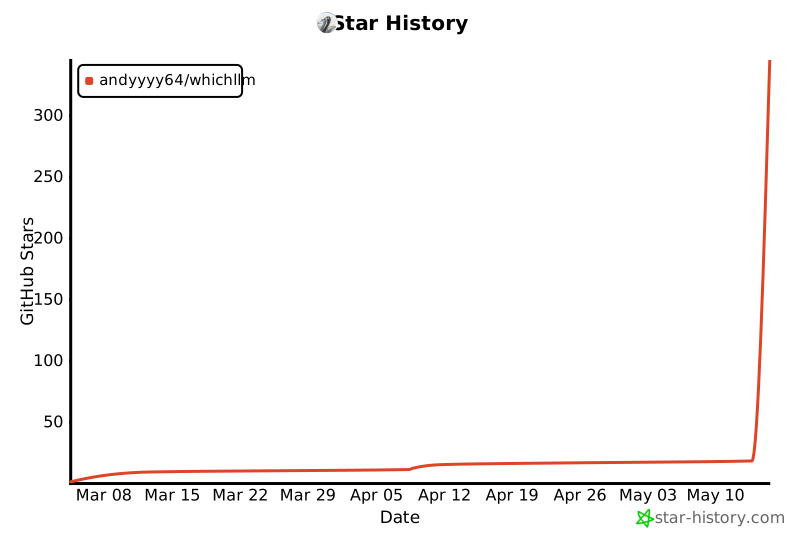](https://www.star-history.com/#Andyyyy64/whichllm&Date)
|
||
|
||
## Requirements
|
||
|
||
- Python 3.11+
|
||
- NVIDIA GPU detection via `nvidia-ml-py` (included by default)
|
||
- AMD / Apple Silicon detected automatically
|
||
|
||
## License
|
||
|
||
MIT
|