 wehub-resource-sync
97e91a83f3
wehub-resource-sync
97e91a83f3
Ruff / Ruff (push) Has been cancelled
Test / Core Tests (push) Has been cancelled
Test / Offline Coverage Tests (Python 3.10) (push) Has been cancelled
Test / Offline Coverage Tests (Python 3.11) (push) Has been cancelled
Test / Offline Coverage Tests (Python 3.12) (push) Has been cancelled
Test / Offline Coverage Tests (Python 3.13) (push) Has been cancelled
Test / Offline Coverage Tests (Python 3.9) (push) Has been cancelled
Test / Full Coverage (Python 3.11) (push) Has been cancelled
Test / Core Provider Tests (OpenAI) (push) Has been cancelled
Test / Core Provider Tests (Anthropic) (push) Has been cancelled
Test / Core Provider Tests (Google) (push) Has been cancelled
Test / Core Provider Tests (Other) (push) Has been cancelled
Test / Anthropic Tests (push) Has been cancelled
Test / Gemini Tests (push) Has been cancelled
Test / Google GenAI Tests (push) Has been cancelled
Test / Vertex AI Tests (push) Has been cancelled
Test / OpenAI Tests (push) Has been cancelled
Test / Writer Tests (push) Has been cancelled
Test / Auto Client Tests (push) Has been cancelled
ty / type-check (push) Has been cancelled
275 lines
8.5 KiB
Markdown
275 lines
8.5 KiB
Markdown
---
|
|
title: Observability & Tracing with Langfuse
|
|
description: Learn how to trace and monitor Instructor API calls using Langfuse for comprehensive observability in your LLM applications.
|
|
---
|
|
|
|
# Observability & Tracing with Langfuse
|
|
|
|
**What is Langfuse?**
|
|
|
|
> **What is Langfuse?** [Langfuse](https://langfuse.com) ([GitHub](https://github.com/langfuse/langfuse)) is an open source LLM engineering platform that helps teams trace API calls, monitor performance, and debug issues in their AI applications.
|
|
|
|
|
|
|
|
This cookbook shows how to use Langfuse to trace and monitor model calls made with the Instructor library.
|
|
|
|
## Setup
|
|
|
|
> **Note** : Before continuing with this section, make sure that you've signed up for an account with [Langfuse](https://langfuse.com). You'll need your private and public key to start tracing with Langfuse.
|
|
|
|
First, let's start by installing the necessary dependencies.
|
|
|
|
```python
|
|
pip install langfuse instructor
|
|
```
|
|
|
|
It is easy to use instructor with Langfuse. We use the [Langfuse OpenAI Integration](https://langfuse.com/docs/integrations/openai) and simply patch the client with instructor. This works with both synchronous and asynchronous clients.
|
|
|
|
### Langfuse-Instructor integration with synchronous OpenAI client
|
|
|
|
```python
|
|
import instructor
|
|
from langfuse.openai import openai
|
|
from pydantic import BaseModel
|
|
import os
|
|
|
|
# Set your API keys Here
|
|
os.environ["LANGFUSE_PUBLIC_KEY"] = "pk-..."
|
|
os.environ["LANGFUSE_SECRET_KEY"] = "sk-..."
|
|
os.environ["LANGFUSE_HOST"] = "https://us.cloud.langfuse.com"
|
|
os.environ["OPENAI_API_KEY] = "sk-..."
|
|
|
|
# Patch Langfuse wrapper of synchronous OpenAI client with instructor
|
|
client = instructor.from_provider("openai/gpt-5-nano")
|
|
|
|
|
|
class WeatherDetail(BaseModel):
|
|
city: str
|
|
temperature: int
|
|
|
|
|
|
# Run synchronous OpenAI client
|
|
weather_info = client.create(
|
|
model="gpt-4o",
|
|
response_model=WeatherDetail,
|
|
messages=[
|
|
{"role": "user", "content": "The weather in Paris is 18 degrees Celsius."},
|
|
],
|
|
)
|
|
|
|
print(weather_info.model_dump_json(indent=2))
|
|
"""
|
|
{
|
|
"city": "Paris",
|
|
"temperature": 18
|
|
}
|
|
"""
|
|
```
|
|
|
|
Once we've run this request succesfully, we'll see that we have a trace avaliable in the Langfuse dashboard for you to look at.
|
|
|
|
### Langfuse-Instructor integration with asychnronous OpenAI client
|
|
|
|
```python
|
|
import instructor
|
|
from langfuse.openai import openai
|
|
from pydantic import BaseModel
|
|
import os
|
|
import asyncio
|
|
|
|
# Set your API keys Here
|
|
os.environ["LANGFUSE_PUBLIC_KEY"] = "pk-"
|
|
os.environ["LANGFUSE_SECRET_KEY"] = "sk-"
|
|
os.environ["LANGFUSE_HOST"] = "https://us.cloud.langfuse.com"
|
|
os.environ["OPENAI_API_KEY] = "sk-..."
|
|
|
|
|
|
# Patch Langfuse wrapper of synchronous OpenAI client with instructor
|
|
client = instructor.from_provider("openai/gpt-5-nano", async_client=True)
|
|
|
|
|
|
class WeatherDetail(BaseModel):
|
|
city: str
|
|
temperature: int
|
|
|
|
|
|
async def main():
|
|
# Run synchronous OpenAI client
|
|
weather_info = await client.create(
|
|
model="gpt-4o",
|
|
response_model=WeatherDetail,
|
|
messages=[
|
|
{"role": "user", "content": "The weather in Paris is 18 degrees Celsius."},
|
|
],
|
|
)
|
|
|
|
print(weather_info.model_dump_json(indent=2))
|
|
"""
|
|
{
|
|
"city": "Paris",
|
|
"temperature": 18
|
|
}
|
|
"""
|
|
|
|
|
|
asyncio.run(main())
|
|
|
|
```
|
|
|
|
Here's a [public link](https://cloud.langfuse.com/project/cloramnkj0002jz088vzn1ja4/traces/0da3f599-b807-4e14-9888-cf68fa53d976?timestamp=2025-03-31T16:12:40.076Z&display=details) to the trace that we generated which you can view in Langfuse.
|
|
|
|
## Example
|
|
|
|
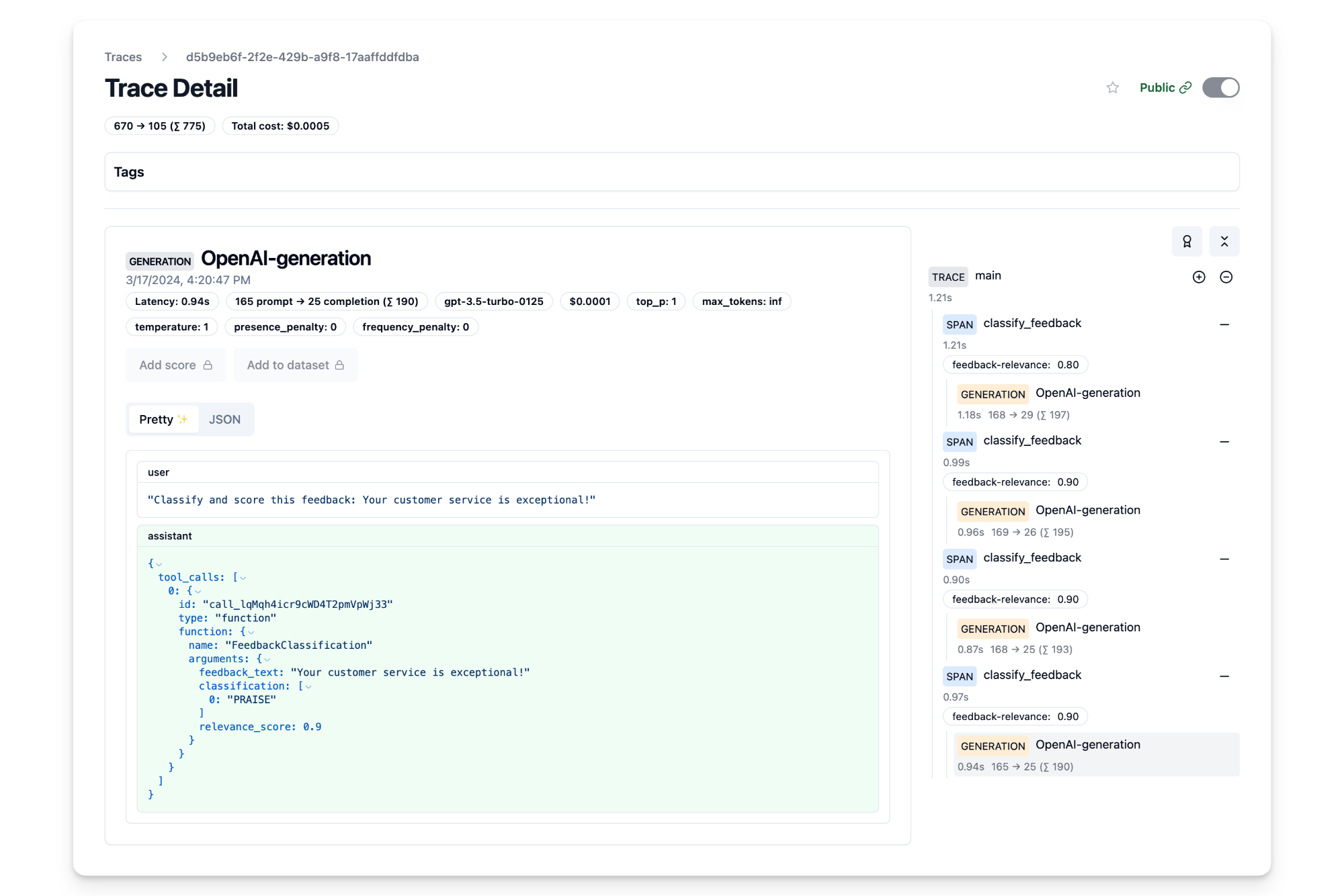
In this example, we first classify customer feedback into categories like `PRAISE`, `SUGGESTION`, `BUG` and `QUESTION`, and further scores the relevance of each feedback to the business on a scale of 0.0 to 1.0. In this case, we use the asynchronous OpenAI client `AsyncOpenAI` to classify and evaluate the feedback.
|
|
|
|
```python
|
|
from enum import Enum
|
|
|
|
import asyncio
|
|
import instructor
|
|
|
|
from langfuse import Langfuse
|
|
from langfuse.openai import AsyncOpenAI
|
|
from langfuse.decorators import langfuse_context, observe
|
|
|
|
from pydantic import BaseModel, Field, field_validator
|
|
import os
|
|
|
|
# Set your API keys Here
|
|
os.environ["LANGFUSE_PUBLIC_KEY"] = "pk-..."
|
|
os.environ["LANGFUSE_SECRET_KEY"] = "sk-..."
|
|
os.environ["LANGFUSE_HOST"] = "https://us.cloud.langfuse.com"
|
|
os.environ["OPENAI_API_KEY] = "sk-..."
|
|
|
|
|
|
|
|
client = instructor.from_provider("openai/gpt-5-nano", async_client=True)
|
|
|
|
# Initialize Langfuse (needed for scoring)
|
|
langfuse = Langfuse()
|
|
|
|
# Rate limit the number of requests
|
|
sem = asyncio.Semaphore(5)
|
|
|
|
|
|
# Define feedback categories
|
|
class FeedbackType(Enum):
|
|
PRAISE = "PRAISE"
|
|
SUGGESTION = "SUGGESTION"
|
|
BUG = "BUG"
|
|
QUESTION = "QUESTION"
|
|
|
|
|
|
# Model for feedback classification
|
|
class FeedbackClassification(BaseModel):
|
|
feedback_text: str = Field(...)
|
|
classification: list[FeedbackType] = Field(
|
|
description="Predicted categories for the feedback"
|
|
)
|
|
relevance_score: float = Field(
|
|
default=0.0,
|
|
description="Score of the query evaluating its relevance to the business between 0.0 and 1.0",
|
|
)
|
|
|
|
# Make sure feedback type is list
|
|
@field_validator("classification", mode="before")
|
|
def validate_classification(cls, v):
|
|
if not isinstance(v, list):
|
|
v = [v]
|
|
return v
|
|
|
|
|
|
@observe() # Langfuse decorator to automatically log spans to Langfuse
|
|
async def classify_feedback(feedback: str):
|
|
"""
|
|
Classify customer feedback into categories and evaluate relevance.
|
|
"""
|
|
async with sem: # simple rate limiting
|
|
response = await client.create(
|
|
model="gpt-4o",
|
|
response_model=FeedbackClassification,
|
|
max_retries=2,
|
|
messages=[
|
|
{
|
|
"role": "user",
|
|
"content": f"Classify and score this feedback: {feedback}",
|
|
},
|
|
],
|
|
)
|
|
|
|
# Retrieve observation_id of current span
|
|
observation_id = langfuse_context.get_current_observation_id()
|
|
|
|
return feedback, response, observation_id
|
|
|
|
|
|
def score_relevance(trace_id: str, observation_id: str, relevance_score: float):
|
|
"""
|
|
Score the relevance of a feedback query in Langfuse given the observation_id.
|
|
"""
|
|
langfuse.score(
|
|
trace_id=trace_id,
|
|
observation_id=observation_id,
|
|
name="feedback-relevance",
|
|
value=relevance_score,
|
|
)
|
|
|
|
|
|
@observe() # Langfuse decorator to automatically log trace to Langfuse
|
|
async def main(feedbacks: list[str]):
|
|
tasks = [classify_feedback(feedback) for feedback in feedbacks]
|
|
results = []
|
|
|
|
for task in asyncio.as_completed(tasks):
|
|
feedback, classification, observation_id = await task
|
|
result = {
|
|
"feedback": feedback,
|
|
"classification": [c.value for c in classification.classification],
|
|
"relevance_score": classification.relevance_score,
|
|
}
|
|
results.append(result)
|
|
|
|
# Retrieve trace_id of current trace
|
|
trace_id = langfuse_context.get_current_trace_id()
|
|
|
|
# Score the relevance of the feedback in Langfuse
|
|
score_relevance(trace_id, observation_id, classification.relevance_score)
|
|
|
|
# Flush observations to Langfuse
|
|
langfuse_context.flush()
|
|
return results
|
|
|
|
|
|
feedback_messages = [
|
|
"The chat bot on your website does not work.",
|
|
"Your customer service is exceptional!",
|
|
"Could you add more features to your app?",
|
|
"I have a question about my recent order.",
|
|
]
|
|
|
|
feedback_classifications = asyncio.run(main(feedback_messages))
|
|
|
|
for classification in feedback_classifications:
|
|
print(f"Feedback: {classification['feedback']}")
|
|
print(f"Classification: {classification['classification']}")
|
|
print(f"Relevance Score: {classification['relevance_score']}")
|
|
|
|
|
|
"""
|
|
Feedback: I have a question about my recent order.
|
|
Classification: ['QUESTION']
|
|
Relevance Score: 0.0
|
|
Feedback: Could you add more features to your app?
|
|
Classification: ['SUGGESTION']
|
|
Relevance Score: 0.0
|
|
Feedback: The chat bot on your website does not work.
|
|
Classification: ['BUG']
|
|
Relevance Score: 0.9
|
|
Feedback: Your customer service is exceptional!
|
|
Classification: ['PRAISE']
|
|
Relevance Score: 0.9
|
|
"""
|
|
```
|
|
|
|
We can see that with Langfuse, we were able to generate these different completions and view them with our own UI. Click here to see the [public trace](https://cloud.langfuse.com/project/cloramnkj0002jz088vzn1ja4/traces/ba27e7b1-e23e-4f50-87de-420cf038190f?timestamp=2025-03-31T16:12:57.041Z&display=details) for the 5 completions that we generated.
|