 wehub-resource-sync
3.2 KiB
This example is a visual walkthrough of the paper "Differentiable Block Worlds". All the visualizations were created by editing the original source code to log data with the Rerun SDK.
Visual paper walkthrough
Finding a textured mesh decomposition from a collection of posed images is a very challenging optimization problem. "Differentiable Block Worlds" by Tom Monnier et al. shows impressive results using differentiable rendering. Here we visualize how this optimization works using the Rerun SDK.
https://vimeo.com/865326948?autoplay=1&loop=1&autopause=0&background=1&muted=1&ratio=10000:7309
In "Differentiable Blocks World: Qualitative 3D Decomposition by Rendering Primitives" the authors describe an optimization of a background icosphere, a ground plane, and multiple superquadrics. The goal is to find the shapes and textures that best explain the observations.
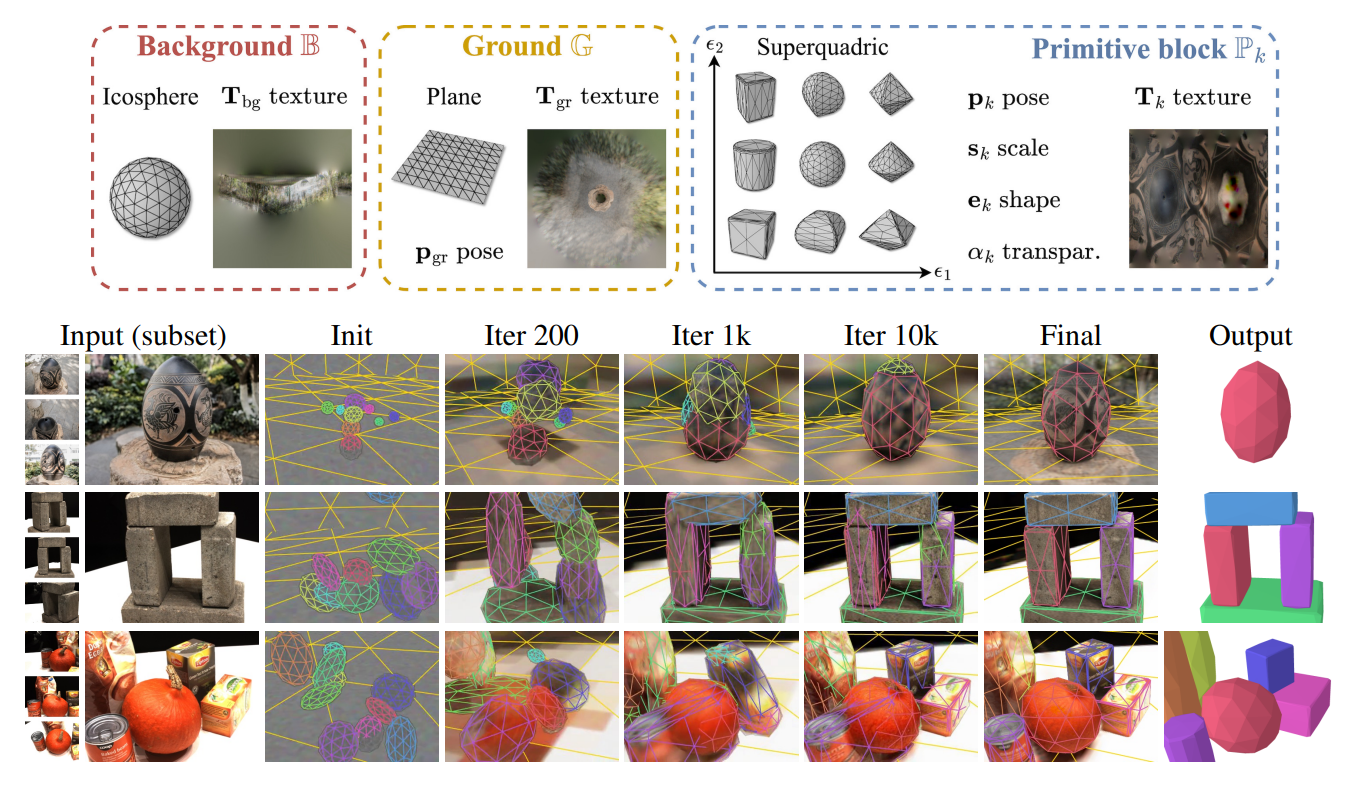
The optimization is initialized with an initial set of superquadrics ("blocks"), a ground plane, and a sphere for the background. From here, the optimization can only reduce the number of blocks, not add additional ones.
https://vimeo.com/865327350?autoplay=1&loop=1&autopause=0&background=1&muted=1&ratio=10000:6497
A key difference to other differentiable renderers is the addition of transparency handling. Each mesh has an opacity associated with it that is optimized. When the opacity becomes lower than a threshold the mesh is discarded in the visualization. This allows to optimize the number of meshes.
https://vimeo.com/865327387?autoplay=1&loop=1&autopause=0&background=1&muted=1&ratio=10000:7037
To stabilize the optimization and avoid local minima, a 3-stage optimization is employed:
- the texture resolution is reduced by a factor of 8,
- the full resolution texture is optimized, and
- transparency-based optimization is deactivated, only optimizing the opaque meshes from here.
https://vimeo.com/865329177?autoplay=1&loop=1&autopause=0&background=1&muted=1&ratio=10000:8845
Make sure to read the paper by Tom Monnier, Jake Austin, Angjoo Kanazawa, Alexei A. Efros, Mathieu Aubry. Interesting study of how to approach such a difficult optimization problem.