---
title: Catalog object model
order: 100
---
This page covers the catalog server's object model. For logging and recording basics, see [Recordings](../logging-and-ingestion/recordings.md). For API details, see the [Catalog SDK reference](https://ref.rerun.io/docs/python/stable/common/catalog/).
## Catalog
We refer to the contents stored in a given catalog server as the _catalog_.
The catalog contains top-level objects called _entries_.
There are currently two types of entries: **tables** and **datasets**.
Each is described in more detail below.
Entries share a few common properties:
- **id**: a globally unique identifier
- **name**: a user-provided name, which must be unique within the catalog
### Renaming a catalog entry
The id of a catalog entry is immutable, but the name can be changed provided it remains unique.
In Python, call `set_name()` on an entry to rename it on the catalog server, for example:
```python
client = rr.catalog.CatalogClient(…)
dataset = client.get_dataset("old_name")
dataset.set_name("new_name")
```
### Structuring datasets
When working with larger amounts of data, it can be useful to organize catalog entries in a directory-like structure.
This can be done by using `.` delimiters in the names.
The screenshot below is an example of a dot-delimited dataset name showing up as a directory tree in the viewer's data source browser:
## Table entries
Table entries model a single table of data.
They use the [Arrow data model](https://arrow.apache.org/docs/format/Columnar.html), so a table is logically equivalent to an [Arrow table](https://arrow.apache.org/docs/python/generated/pyarrow.Table.html).
As a result, tables possess an [Arrow schema](https://arrow.apache.org/docs/python/generated/pyarrow.Schema.html).
Tables support the following mutation operations through the Catalog SDK:
- _append_: add new rows to the table
- _overwrite_: replace the entire table with new data
- _upsert_: replace existing rows (based on an index column) with new data
Thanks to [DataFusion](https://datafusion.apache.org/), tables also support most database operations such as querying, filtering, joining, etc.
## Datasets
Dataset entries model a collection of Rerun data organized in episodes such as recorded runs of a given robotic task.
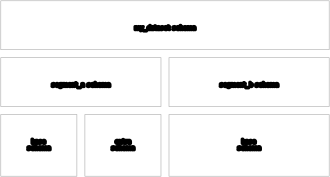
These episodes within datasets are called _segments_, which are identified by a segment ID.
Segments are added to datasets by the process of _registering_ a [recording](../logging-and-ingestion/recordings.md) (typically stored in some object store such as S3) to the dataset using the Catalog SDK.
The recording ID of the `.rrd` file is used as its segment ID.
Recordings registered to a given segment are organized by layers, identified by a layer name.
By default, the `"base"` layer name is used.
Registering two `.rrd` files with the same recording ID (that is, with the same segment ID) to the same dataset, and using the same layer name, will result in the second `.rrd` overwriting the first.
Additive registration can be achieved by using different layer names for different `.rrd`s with the same recording ID/segment ID.
Layers are immutable and can only be overwritten by registering a new `.rrd` file. In other words, datasets support the following mutation operations:
- _create segment_: by registering a `.rrd` with a "new" recording ID
- _append to segment_: by registering a `.rrd` with a matching recording ID to a new layer name
- _overwrite segment layer_: by registering a `.rrd` with a matching recording ID to an existing layer name
### Schema
Datasets are based on the Rerun data model, which consists of a collection of [chunks](../logging-and-ingestion/chunks.md) of Arrow data.
These chunks hold data for various [entities and components](../logging-and-ingestion/entity-component.md) corresponding to various indexes (or [timelines](../logging-and-ingestion/timelines.md)).
A given collection of chunks, say, a dataset segment, defines an Arrow schema.
We refer to this as _schema-on-read_, because the schema proceeds from the data, and not the other way around.
This differs from the table model, where the schema is defined upfront (_schema-on-write_).
In this context, the schema of a dataset is the union of schemas of its segments, which themselves are the union of the schemas of their layers.
Datasets maintain a minimal level of schema self-consistency.
Registering a `.rrd` whose schema is incompatible with the current dataset schema will result in an error.
In this context, _incompatible_ means that the schema of the new `.rrd` contains a column for the same entity, archetype, and component, but with a different Arrow type.
Such an occurrence is rare, and practically impossible when using standard Rerun archetypes.
### Blueprints
A dataset can be assigned a blueprint.
This is done by registering a `.rbl` blueprint file typically stored in object storage to the dataset.
A dedicated API exists for this in the Catalog SDK: [`DatasetEntry.register_blueprint()`](https://ref.rerun.io/docs/python/stable/common/catalog/#rerun.catalog.DatasetEntry.register_blueprint).
In that case, the blueprint is applied to all segments of the dataset when visualized in the Rerun Viewer.