---
# These are optional elements. Feel free to remove any of them.
status: experimental
contact: crickman
date: 2024-01-24
deciders: markwallace-microsoft, matthewbolanos
consulted: rogerbarreto, dmytrostruk, alliscode, SergeyMenshykh
informed:
---
# SK Agents Overview and High Level Design
## **Context and Problem Statement**
Support for the OpenAI Assistant API was published in an experimental `*.Assistants` package that was later renamed to `*.Agents` with the aspiration of pivoting to a more general agent framework.
The initial `Assistants` work was never intended to evolve into a general _Agent Framework_.
This ADR defines that general _Agent Framework_.
An agent is expected to be able to support two interaction patterns:
1. **Direct Invocation ("No Chat"):**
The caller is able to directly invoke any single agent without any intervening machinery or infrastructure.
For different agents to take turns in a conversation using direct invocation, the caller is expected to invoke each agent per turn.
Coordinating interaction between different agent types must also be explicitly managed by the caller.
2. **Agent Chat:**
The caller is able to assemble multiple agents to participate in an extended conversation for the purpose of accomplishing a specific goal
(generally in response to initial or iterative input). Once engaged, agents may participate in the chat over multiple interactions by taking turns.
## **Agents Overview**
Fundamentally an agent possesses the following characteristics:
- Identity: Allows each agent to be uniquely identified.
- Behavior: The manner in which an agent participates in a conversation
- Interaction: That an agent behavior is in response to other agents or input.
Various agents specializations might include:
- System Instructions: A set of directives that guide the agent's behavior.
- Tools/Functions: Enables the agent to perform specific tasks or actions.
- Settings: Agent specific settings. For chat-completion agents this might include LLM settings - such as Temperature, TopP, StopSequence, etc
### **Agent Modalities**
An _Agent_ can be of various modalities. Modalities are asymmetrical with regard to abilities and constraints.
- **SemanticKernel - ChatCompletion**: An _Agent_ based solely on the *SemanticKernel* support for chat-completion (e.g. .NET `ChatCompletionService`).
- **OpenAI Assistants**: A hosted _Agent_ solution supported the _OpenAI Assistant API_ (both OpenAI & Azure OpenAI).
- **Custom**: A custom agent developed by extending the _Agent Framework_.
- **Future**: Yet to be announced, such as a HuggingFace Assistant API (they already have assistants, but yet to publish an API.)
## **Decision Drivers**
- _Agent Framework_ shall provide sufficient abstraction to enable the construction of agents that could utilize potentially any LLM API.
- _Agent Framework_ shall provide sufficient abstraction and building blocks for the most frequent types of agent collaboration. It should be easy to add new blocks as new collaboration methods emerge.
- _Agent Framework_ shall provide building blocks to modify agent input and output to cover various customization scenarios.
- _Agent Framework_ shall align with _SemanticKernel_ patterns: tools, DI, plugins, function-calling, etc.
- _Agent Framework_ shall be extensible so that other libraries can build their own agents and chat experiences.
- _Agent Framework_ shall be as simple as possible to facilitate extensibility.
- _Agent Framework_ shall encapsulate complexity within implementation details, not calling patterns.
- _Agent_ abstraction shall support different modalities (see [Agent Modalities](#agent-modalities) section).
- An _Agent_ of any modality shall be able to interact with an _Agent_ of any other modality.
- An _Agent_ shall be able to support its own modality requirements. (Specialization)
- _Agent_ input and output shall align to SK content type `ChatMessageContent`.
## **Design - Analysis**
Agents participate in a conversation, often in response to user or environmental input.

In addition to `Agent`, two fundamental concepts are identified from this pattern:
- Conversation - Context for sequence of agent interactions.
- Channel: ("Communication Path" from diagram) - The associated state and protocol with which the agent interacts with a single conversation.
> Agents of different modalities must be free to satisfy the requirements presented by their modality. Formalizing the `Channel` concept provides a natural vehicle for this to occur.
For an agent based on _chat-completion_, this means owning and managing a specific set of chat messages (chat-history) and communicating with a chat-completion API / endpoint.
For an agent based on the _Open AI Assistant API_, this means defining a specific _thread_ and communicating with the Assistant API as a remote service.
These concepts come together to suggest the following generalization:
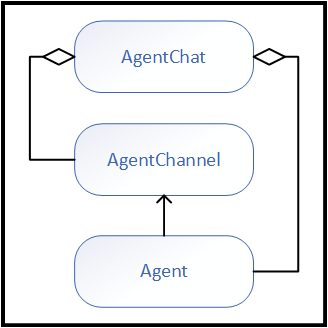
After iterating with the team over these concepts, this generalization translates into the following high-level definitions:

Class Name|Parent Class|Role|Modality|Note
-|-|-|-|-
Agent|-|Agent|Abstraction|Root agent abstraction
KernelAgent|Agent|Agent|Abstraction|Includes `Kernel` services and plug-ins
AgentChannel|-|Channel|Abstraction|Conduit for an agent's participation in a chat.
AgentChat|-|Chat|Abstraction|Provides core capabilities for agent interactions.
AgentGroupChat|AgentChat|Chat|Utility|Strategy based chat
---
## **Design - Abstractions**
Here the detailed class definitions from the high-level pattern from the previous section are enumerated.
Also shown are entities defined as part of the _ChatHistory_ optimization: `IChatHistoryHandler`, `ChatHistoryKernelAgent`, and `ChatHistoryChannel`.
These _ChatHistory_ entities eliminates the requirement for _Agents_ that act on a locally managed `ChatHistory` instance (as opposed to agents managed via remotely hosted frameworks) to implement their own `AgentChannel`.

Class Name|Parent Class|Role|Modality|Note
-|-|-|-|-
Agent|-|Agent|Abstraction|Root agent abstraction
AgentChannel|-|Channel|Abstraction|Conduit for an agent's participation in an `AgentChat`.
KernelAgent|Agent|Agent|Abstraction|Defines `Kernel` services and plug-ins
ChatHistoryChannel|AgentChannel|Channel|Abstraction|Conduit for agent participation in a chat based on local chat-history.
IChatHistoryHandler|-|Agent|Abstraction|Defines a common part for agents that utilize `ChatHistoryChannel`.
ChatHistoryKernelAgent|KernelAgent|Agent|Abstraction|Common definition for any `KernelAgent` that utilizes a `ChatHistoryChannel`.
AgentChat|-|Chat|Abstraction|Provides core capabilities for an multi-turn agent conversation.
---
## **Design - Chat-Completion Agent**
The first concrete agent is `ChatCompletionAgent`.
The `ChatCompletionAgent` implementation is able to integrate with any `IChatCompletionService` implementation.
Since `IChatCompletionService` acts upon `ChatHistory`, this demonstrates how `ChatHistoryKernelAgent` may be simply implemented.
Agent behavior is (naturally) constrained according to the specific behavior of any `IChatCompletionService`.
For example, a connector that does not support function-calling will likewise not execute any `KernelFunction` as an _Agent_.
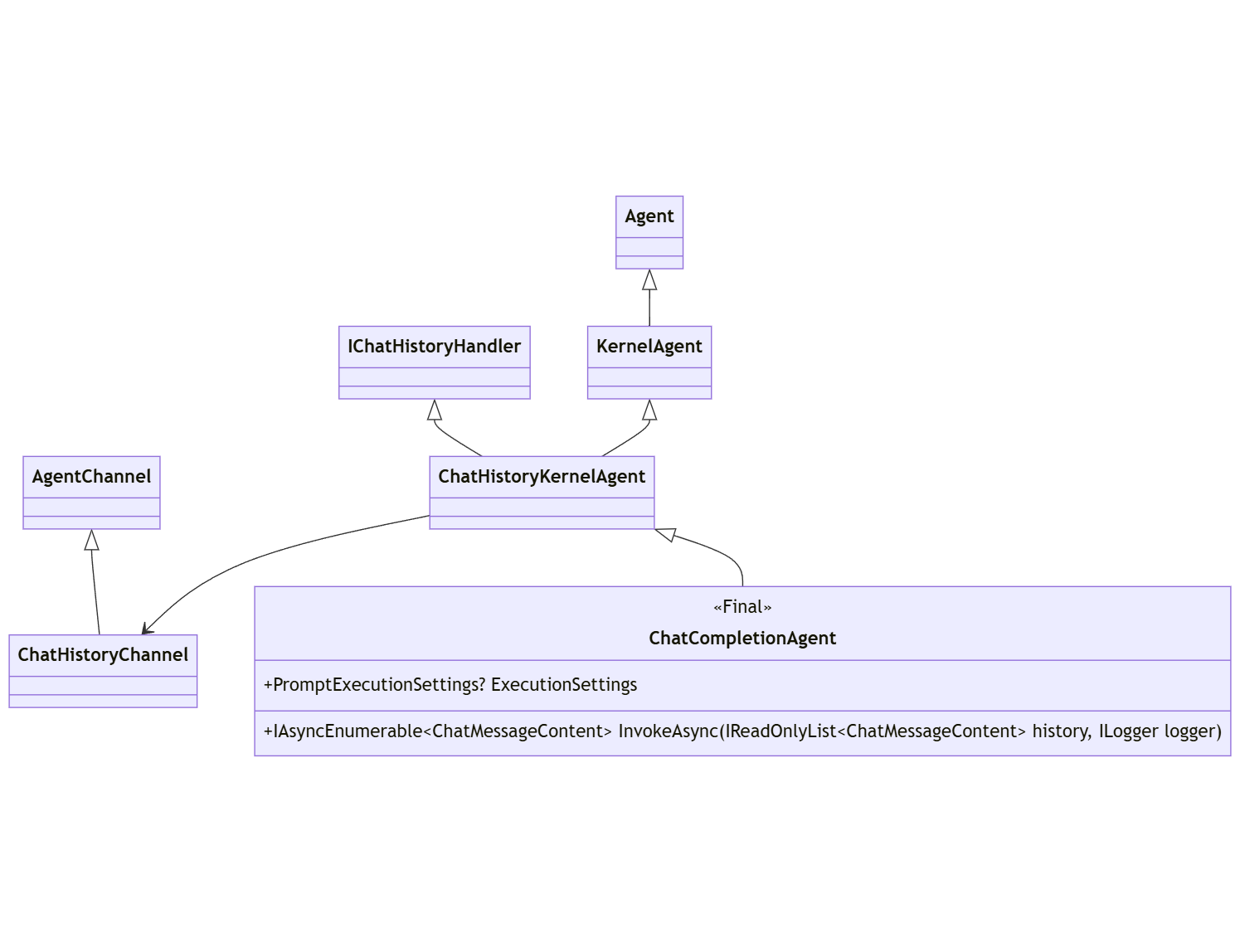
Class Name|Parent Class|Role|Modality|Note
-|-|-|-|-
ChatCompletionAgent|ChatHistoryKernelAgent|Agent|SemanticKernel|Concrete _Agent_ based on a local chat-history.
---
## **Design - Group Chat**
`AgentGroupChat` is a concrete `AgentChat` whose behavior is defined by various _Strategies_.

Class Name|Parent Class|Role|Modality|Note
-|-|-|-|-
AgentGroupChat|AgentChat|Chat|Utility|Strategy based chat
AgentGroupChatSettings|-|Config|Utility|Defines strategies that affect behavior of `AgentGroupChat`.
SelectionStrategy|-|Config|Utility|Determines the order for `Agent` instances to participate in `AgentGroupChat`.
TerminationStrategy|-|Config|Utility|Determines when the `AgentGroupChat` conversation is allowed to terminate (no need to select another `Agent`).
---
## **Design - OpenAI Assistant Agent**
The next concrete agent is `OpenAIAssistantAgent`.
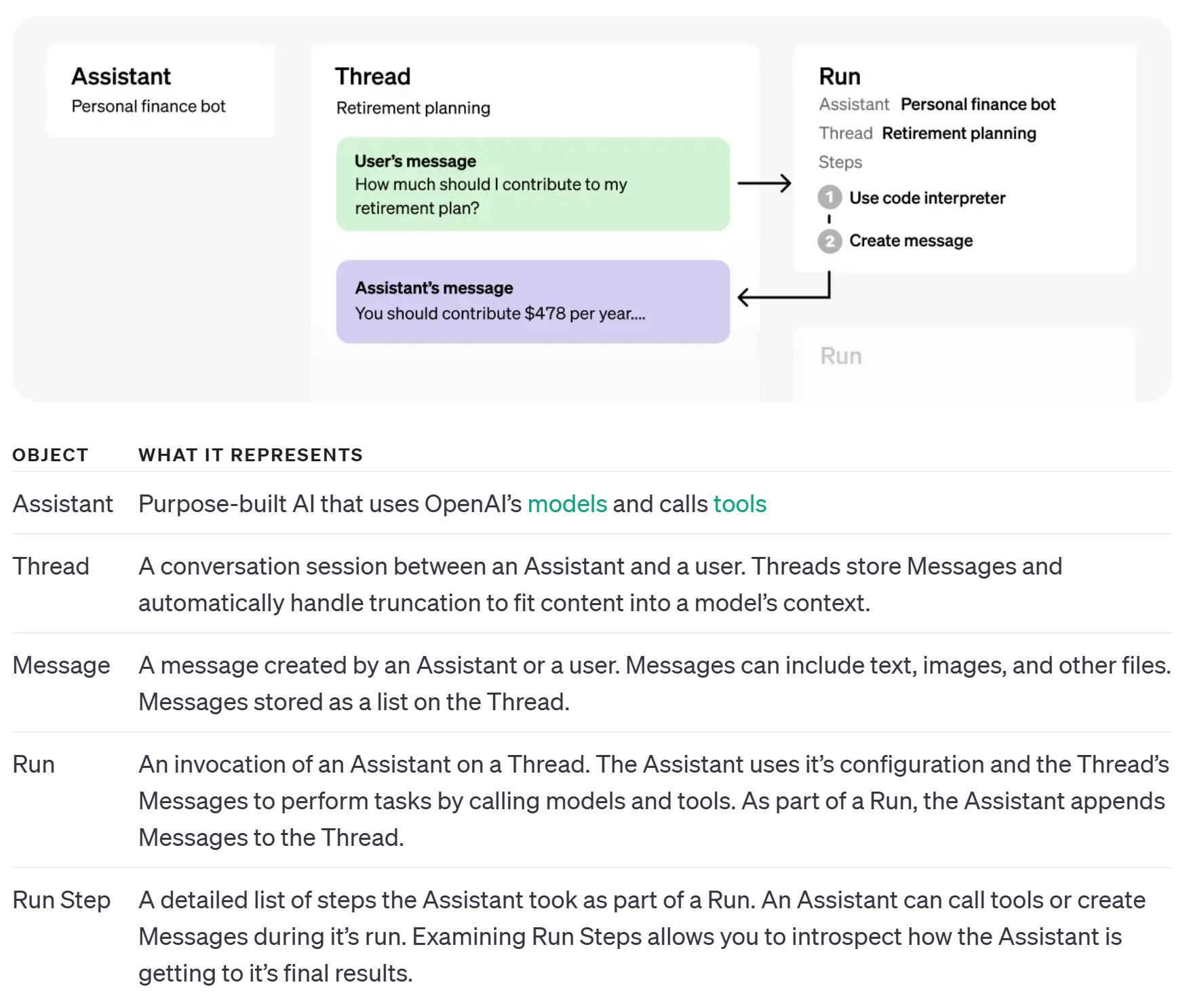
This agent is based on the _OpenAI Assistant API_ and implements its own channel as chat history is managed remotely as an assistant _thread_.

Class Name|Parent Class|Role|Modality|Note
-|-|-|-|-
OpenAIAssistantAgent|KernelAgent|Agent|OpenAI Assistant|A functional agent based on _OpenAI Assistant API_
OpenAIAssistantChannel|AgentChannel|Channel|OpenAI Assistant|Channel associated with `OpenAIAssistantAgent`
OpenAIAssistantDefinition|-|Config|OpenAI Assistant|Definition of an _Open AI Assistant_ provided when enumerating over hosted agent definitions.
---
### **OpenAI Assistant API Reference**
- [Assistants Documentation](https://platform.openai.com/docs/assistants)
- [Assistants API](https://platform.openai.com/docs/api-reference/assistants)
## **Design - Aggregator Agent**
In order to support complex calling patterns, `AggregatorAgent` enables one or more agents participating in an `AgentChat` to present as a single logical `Agent`.

Class Name|Parent Class|Role|Modality|Note
-|-|-|-|-
AggregatorAgent|Agent|Agent|Utility|Adapts an `AgentChat` as an `Agent`
AggregatorChannel|AgentChannel|Channel|Utility|`AgentChannel` used by `AggregatorAgent`.
AggregatorMode|-|Config|Utility|Defines the aggregation mode for `AggregatorAgent`.
---
## **Usage Patterns**
**1. Agent Instantiation: ChatCompletion**
Creating a `ChatCompletionAgent` aligns directly with how a `Kernel` object would be defined with an `IChatCompletionService` for outside of the _Agent Framework_,
with the addition of provide agent specific instructions and identity.
(_dotnet_)
```c#
// Start with the Kernel
IKernelBuilder builder = Kernel.CreateBuilder();
// Add any IChatCompletionService
builder.AddOpenAIChatCompletion(...);
// Include desired plugins / functions
builder.Plugins.Add(...);
// Include desired filters
builder.Filters.Add(...);
// Create the agent
ChatCompletionAgent agent =
new()
{
Instructions = "instructions",
Name = "name",
Kernel = builder.Build()
};
```
(_python_)
```python
# Start with the Kernel
kernel = Kernel()
# Add any ChatCompletionClientBase
kernel.add_service(AzureChatCompletion(service_id="agent", ...))
# Include desired plugins / functions
kernel.add_plugin(...)
# Include desired filters (via @kernel.filter decorator)
# Create the agent
agent = ChatCompletionAgent(service_id="agent", kernel=kernel, name="name", instructions="instructions")
```
**2. Agent Instantiation: OpenAI Assistant**
Since every Assistant action is a call to a REST endpoint, `OpenAIAssistantAgent`, top-level operations are realized via static asynchronous factory methods:
**Create:**
(_dotnet_)
```c#
// Start with the Kernel
IKernelBuilder builder = Kernel.CreateBuilder();
// Include desired plugins / functions
builder.Plugins.Add(...);
// Create config and definition
OpenAIServiceConfiguration config = new("apikey", "endpoint");
OpenAIAssistantDefinition definition = new()
{
Instructions = "instructions",
Name = "name",
Model = "gpt-4",
};
// Create the agent
OpenAIAssistantAgent agent =
OpenAIAssistantAgent.CreateAsync(
builder.Build(),
config,
definition);
```
(_python_)
```python
# Start with the Kernel
kernel = Kernel()
# Include desired plugins / functions
kernel.add_plugin(...)
# Create config and definition
config = OpenAIServiceConfiguration("apikey", "endpoint")
definition = OpenAIAssistantDefinition(instructions="instructions", name="name", model="gpt-4")
agent = OpenAIAssistantAgent.create(kernel=kernel, config=config, definition=definition)
```
**Retrieval:**
(_dotnet_)
```c#
// Start with the Kernel
Kernel kernel = ...;
// Create config
OpenAIServiceConfiguration config = new("apikey", "endpoint");
// Create the agent based on an existing definition
OpenAIAssistantAgent agent = OpenAIAssistantAgent.RetrieveAsync(kernel, config, "agent-id");
```
(_python_)
```python
# Start with the Kernel
kernel = Kernel()
# Create config
config = OpenAIServiceConfiguration("apikey", "endpoint")
# Create the agent based on an existing definition
agent = OpenAIAssistantAgent.retrieve(kernel = kernel, config=config, agentid="agent-id")
```
**Inspection:**
(_dotnet_)
```c#
// Create config
OpenAIServiceConfiguration config = new("apikey", "endpoint");
// Enumerate defined agents
IAsyncEnumerable definitions = OpenAIAssistantAgent.ListDefinitionsAsync(config);
```
(_python_)
```python
# Create config
config = OpenAIServiceConfiguration("apikey", "endpoint")
# Enumerate defined agents
definitions = await OpenAIAssistantAgent.list_definitions(config=config)
```
**3. Agent Chat: Explicit**
An _Agent_ may be explicitly targeted to respond in an `AgentGroupChat`.
(_dotnet_)
```c#
// Define agents
ChatCompletionAgent agent1 = ...;
OpenAIAssistantAgent agent2 = ...;
// Create chat
AgentGroupChat chat = new();
// Provide input for chat
ChatMessageContent input = new (AuthorRole.User, "input");
await WriteMessageAsync(input);
chat.AddChatMessage(input);
// First invoke one agent, then the other, display each response.
await WriteMessagesAsync(chat.InvokeAsync(agent1));
await WriteMessagesAsync(chat.InvokeAsync(agent2));
// The entire history may be accessed.
// Agent specific history is an adaptaton of the primary history.
await WriteMessagesAsync(chat.GetHistoryAsync());
await WriteMessagesAsync(chat.GetHistoryAsync(agent1));
await WriteMessagesAsync(chat.GetHistoryAsync(agent2));
```
(_python_)
```python
# Define agents
agent1 = ChatCompletionAgent(...)
agent2 = OpenAIAssistantAgent.create(...)
# Create chat
chat = AgentGroupChat()
# Provide input for chat
input = ChatMessageContent(AuthorRole.User, "input")
await write_message(input)
chat.add_chat_message(input)
# First invoke one agent, then the other, display each response.
await write_message(chat.invoke(agent1))
await write_message(chat.invoke(agent2))
# The entire history may be accessed.
# Agent specific history is an adaptaton of the primary history.
await write_message(chat.get_history())
await write_message(chat.get_history(agent1))
await write_message(chat.get_history(agent2))
```
**4. Agent Chat: Multi-Turn**
_Agents_ may also take multiple turns working towards an objective:
(_dotnet_)
```c#
// Define agents
ChatCompletionAgent agent1 = ...;
OpenAIAssistantAgent agent2 = ...;
ChatCompletionAgent agent3 = ...;
// Create chat with two agents.
AgentGroupChat chat =
new(agent1, agent2)
{
ExecutionSettings =
{
// Chat will continue until it meets the termination criteria.
TerminationionStrategy = new MyTerminationStrategy(),
}
};
// Provide input for chat
ChatMessageContent input = new(AuthorRole.User, "input");
await WriteMessageAsync(input);
chat.AddChatMessage(input);
// Agent may be added to an existing chat
chat.AddAgent(agent3);
// Execute the chat until termination
await WriteMessagesAsync(chat.InvokeAsync());
```
(_python_)
```python
# Define agents
agent1 = ChatCompletionAgent(...)
agent2 = OpenAIAssistantAgent.create(...)
agent3 = ChatCompletionAgent(...)
// Create chat with two agents.
chat =
AgentGroupChat(agent1, agent2)
{
execution_settings =
{
# Chat will continue until it meets the termination criteria.
terminationion_strategy = MyTerminationStrategy(),
}
}
# Provide input for chat
input = ChatMessageContent(AuthorRole.User, "input")
await write_message(input)
chat.add_chat_message(input)
# Agent may be added to an existing chat
chat.add_agent(agent3)
# Execute the chat until termination
await write_message(chat.invoke())
```