 wehub-resource-sync
e06fe8e8c6
wehub-resource-sync
e06fe8e8c6
3.6 KiB
This model was published in HF papers on 2021-11-11 and contributed to Hugging Face Transformers on 2022-01-18.


ViTMAE
ViTMAE is a self-supervised vision model that is pretrained by masking large portions of an image (~75%). An encoder processes the visible image patches and a decoder reconstructs the missing pixels from the encoded patches and mask tokens. After pretraining, the encoder can be reused for downstream tasks like image classification or object detection — often outperforming models trained with supervised learning.
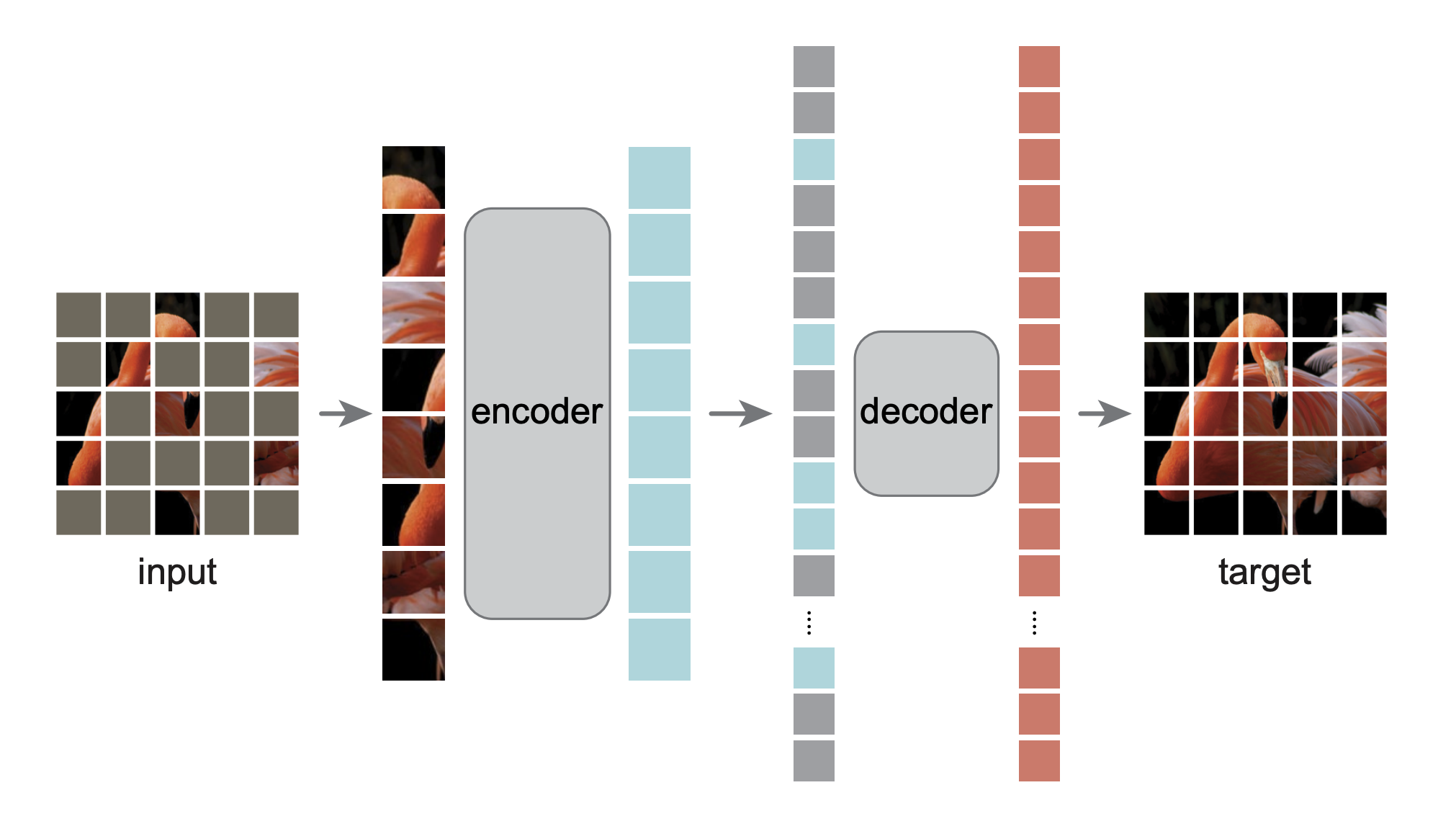
You can find all the original ViTMAE checkpoints under the AI at Meta organization.
Tip
Click on the ViTMAE models in the right sidebar for more examples of how to apply ViTMAE to vision tasks.
The example below demonstrates how to reconstruct the missing pixels with the [ViTMAEForPreTraining] class.
import requests
import torch
from PIL import Image

from transformers import ViTImageProcessor, ViTMAEForPreTraining


url = "https://huggingface.co/datasets/huggingface/documentation-images/resolve/main/pipeline-cat-chonk.jpeg"
image = Image.open(requests.get(url, stream=True).raw)

processor = ViTImageProcessor.from_pretrained("facebook/vit-mae-base")
inputs = processor(image, return_tensors="pt").to(model.device)
inputs = {k: v.to(model.device) for k, v in inputs.items()}

model = ViTMAEForPreTraining.from_pretrained("facebook/vit-mae-base", attn_implementation="sdpa", device_map="auto")
with torch.no_grad():
    outputs = model(**inputs)

reconstruction = outputs.logits
Notes
- ViTMAE is typically used in two stages. Self-supervised pretraining with [
ViTMAEForPreTraining], and then discarding the decoder and fine-tuning the encoder. After fine-tuning, the weights can be plugged into a model like [ViTForImageClassification]. - Use [
ViTImageProcessor] for input preparation.
Resources
- Refer to this notebook to learn how to visualize the reconstructed pixels from [
ViTMAEForPreTraining].
ViTMAEConfig
autodoc ViTMAEConfig
ViTMAEModel
autodoc ViTMAEModel - forward
ViTMAEForPreTraining
autodoc transformers.ViTMAEForPreTraining - forward