 wehub-resource-sync
e06fe8e8c6
wehub-resource-sync
e06fe8e8c6
4.2 KiB
This model was published in HF papers on 2015-12-10 and contributed to Hugging Face Transformers on 2022-03-14.
ResNet
Overview
The ResNet model was proposed in Deep Residual Learning for Image Recognition by Kaiming He, Xiangyu Zhang, Shaoqing Ren and Jian Sun. Our implementation follows the small changes made by Nvidia, we apply the stride=2 for downsampling in bottleneck's 3x3 conv and not in the first 1x1. This is generally known as "ResNet v1.5".
ResNet introduced residual connections, they allow to train networks with an unseen number of layers (up to 1000). ResNet won the 2015 ILSVRC & COCO competition, one important milestone in deep computer vision.
The abstract from the paper is the following:
Deeper neural networks are more difficult to train. We present a residual learning framework to ease the training of networks that are substantially deeper than those used previously. We explicitly reformulate the layers as learning residual functions with reference to the layer inputs, instead of learning unreferenced functions. We provide comprehensive empirical evidence showing that these residual networks are easier to optimize, and can gain accuracy from considerably increased depth. On the ImageNet dataset we evaluate residual nets with a depth of up to 152 layers---8x deeper than VGG nets but still having lower complexity. An ensemble of these residual nets achieves 3.57% error on the ImageNet test set. This result won the 1st place on the ILSVRC 2015 classification task. We also present analysis on CIFAR-10 with 100 and 1000 layers. The depth of representations is of central importance for many visual recognition tasks. Solely due to our extremely deep representations, we obtain a 28% relative improvement on the COCO object detection dataset. Deep residual nets are foundations of our submissions to ILSVRC & COCO 2015 competitions, where we also won the 1st places on the tasks of ImageNet detection, ImageNet localization, COCO detection, and COCO segmentation.
The figure below illustrates the architecture of ResNet. Taken from the original paper.
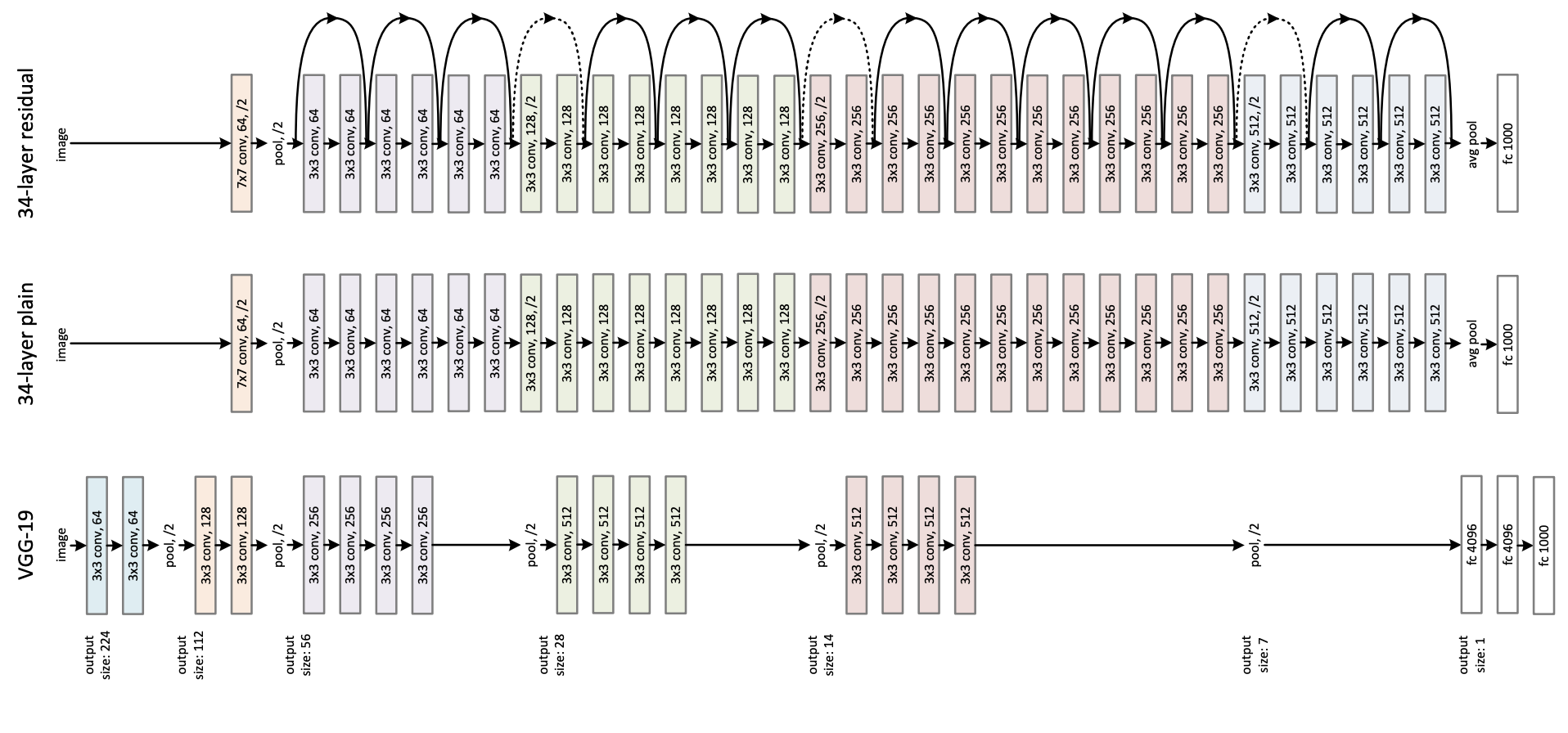
This model was contributed by Francesco. The original code can be found here.
Resources
A list of official Hugging Face and community (indicated by 🌎) resources to help you get started with ResNet.
- [
ResNetForImageClassification] is supported by this example script and notebook. - See also: Image classification task guide
If you're interested in submitting a resource to be included here, please feel free to open a Pull Request and we'll review it! The resource should ideally demonstrate something new instead of duplicating an existing resource.
ResNetConfig
autodoc ResNetConfig
ResNetModel
autodoc ResNetModel - forward
ResNetForImageClassification
autodoc ResNetForImageClassification - forward