 wehub-resource-sync
e06fe8e8c6
wehub-resource-sync
e06fe8e8c6
4.1 KiB
This model was published in HF papers on 2021-08-13 and contributed to Hugging Face Transformers on 2022-09-22.
Conditional DETR
Overview
The Conditional DETR model was proposed in Conditional DETR for Fast Training Convergence by Depu Meng, Xiaokang Chen, Zejia Fan, Gang Zeng, Houqiang Li, Yuhui Yuan, Lei Sun, Jingdong Wang. Conditional DETR presents a conditional cross-attention mechanism for fast DETR training. Conditional DETR converges 6.7× to 10× faster than DETR.
The abstract from the paper is the following:
The recently-developed DETR approach applies the transformer encoder and decoder architecture to object detection and achieves promising performance. In this paper, we handle the critical issue, slow training convergence, and present a conditional cross-attention mechanism for fast DETR training. Our approach is motivated by that the cross-attention in DETR relies highly on the content embeddings for localizing the four extremities and predicting the box, which increases the need for high-quality content embeddings and thus the training difficulty. Our approach, named conditional DETR, learns a conditional spatial query from the decoder embedding for decoder multi-head cross-attention. The benefit is that through the conditional spatial query, each cross-attention head is able to attend to a band containing a distinct region, e.g., one object extremity or a region inside the object box. This narrows down the spatial range for localizing the distinct regions for object classification and box regression, thus relaxing the dependence on the content embeddings and easing the training. Empirical results show that conditional DETR converges 6.7× faster for the backbones R50 and R101 and 10× faster for stronger backbones DC5-R50 and DC5-R101. Code is available at https://github.com/Atten4Vis/ConditionalDETR.
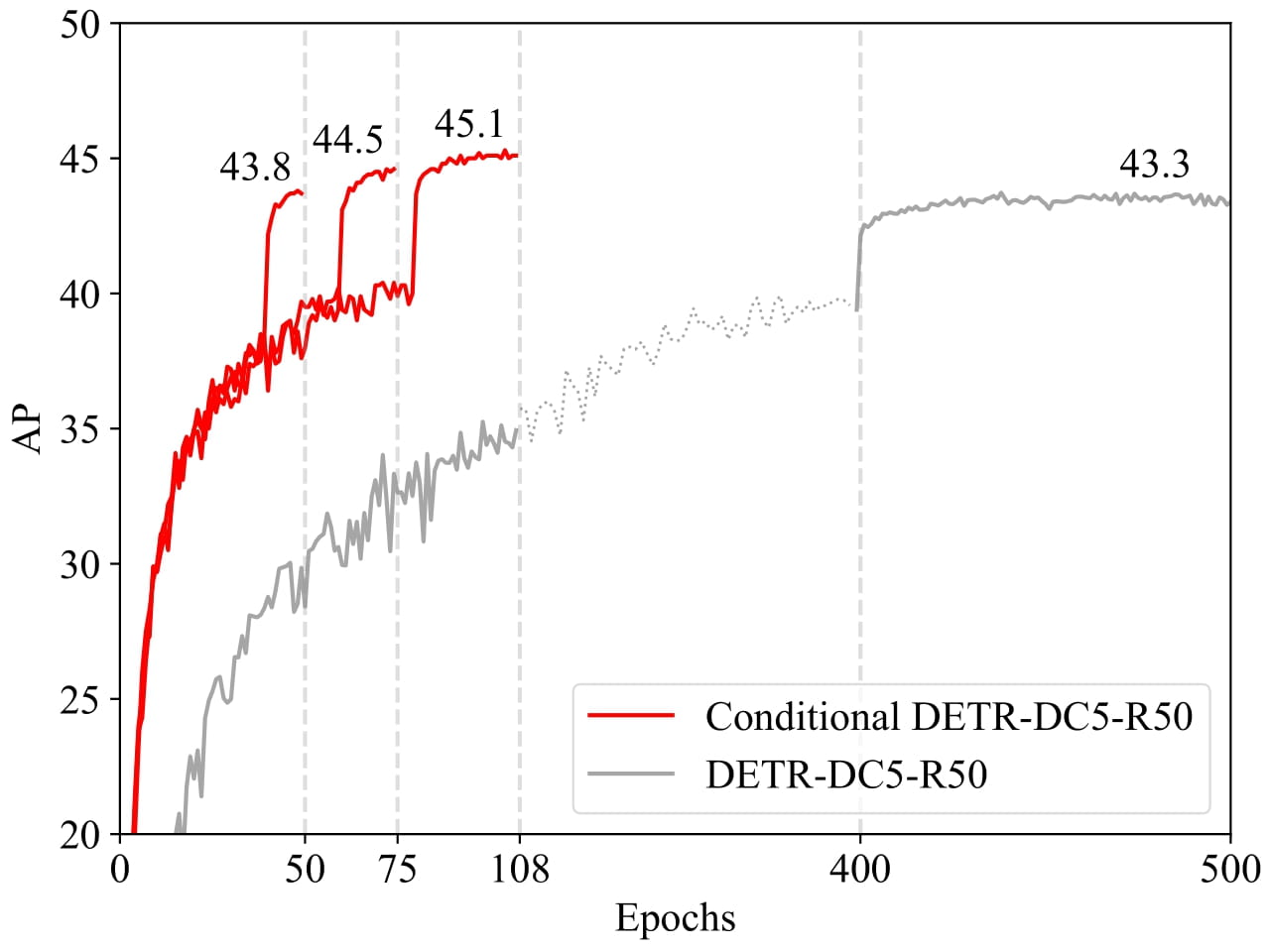
Conditional DETR shows much faster convergence compared to the original DETR. Taken from the original paper.
This model was contributed by DepuMeng. The original code can be found here.
Resources
- Scripts for finetuning [
ConditionalDetrForObjectDetection] with [Trainer] or Accelerate can be found here. - See also: Object detection task guide.
ConditionalDetrConfig
autodoc ConditionalDetrConfig
ConditionalDetrImageProcessor
autodoc ConditionalDetrImageProcessor - preprocess
ConditionalDetrImageProcessorPil
autodoc ConditionalDetrImageProcessorPil - preprocess - post_process_object_detection - post_process_instance_segmentation - post_process_semantic_segmentation - post_process_panoptic_segmentation
ConditionalDetrModel
autodoc ConditionalDetrModel - forward
ConditionalDetrForObjectDetection
autodoc ConditionalDetrForObjectDetection - forward
ConditionalDetrForSegmentation
autodoc ConditionalDetrForSegmentation - forward