 wehub-resource-sync
e06fe8e8c6
wehub-resource-sync
e06fe8e8c6
2.8 KiB
GGUF
GGUF is a file format used to store models for inference with GGML, a fast and lightweight inference framework written in C and C++. GGUF is a single-file format containing the model metadata and tensors.
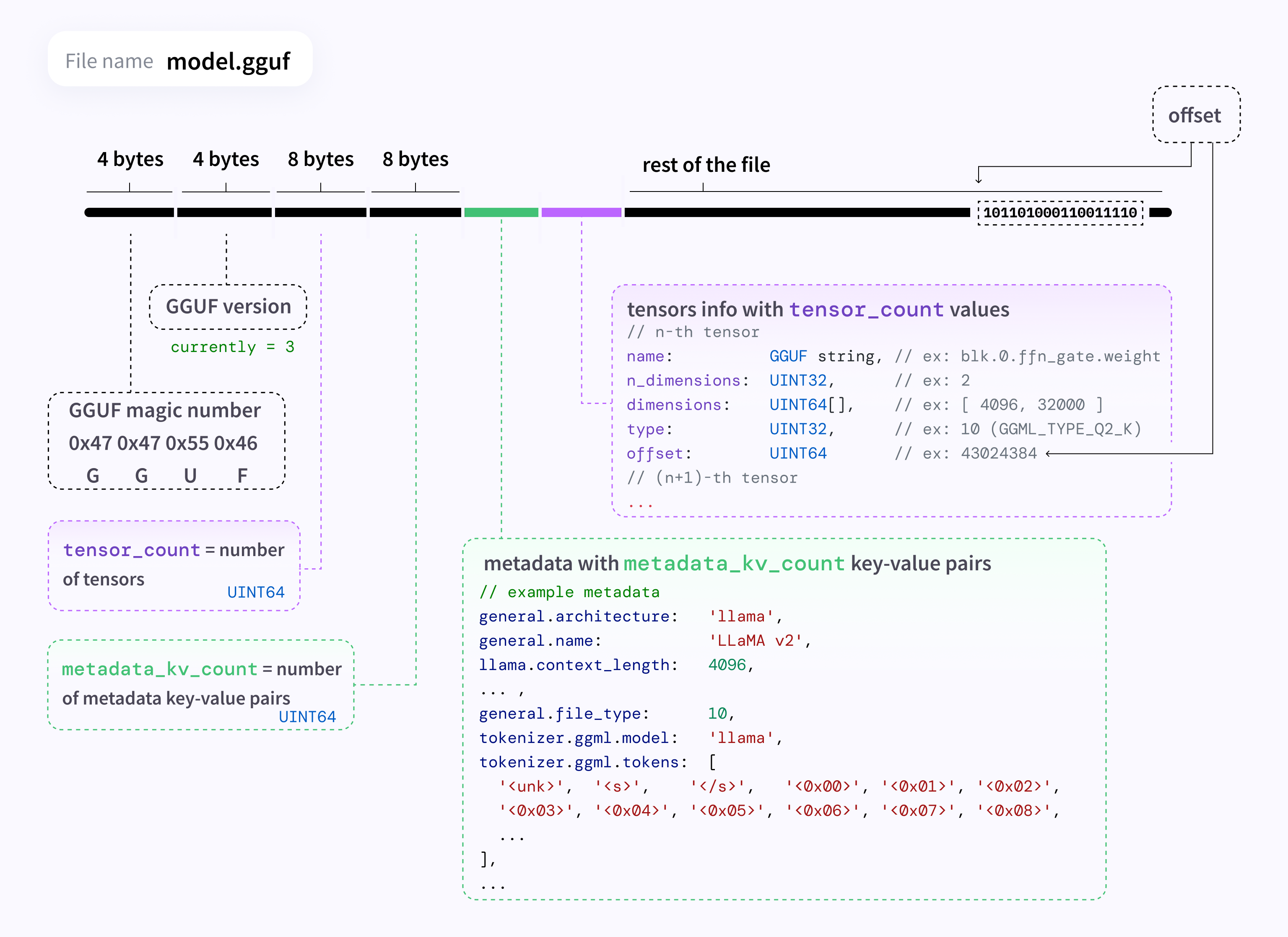
The GGUF format also supports many quantized data types (refer to quantization type table for a complete list of supported quantization types) which saves a significant amount of memory, making inference with large models like Whisper and Llama feasible on local and edge devices.
Transformers supports loading models stored in the GGUF format for further training or finetuning. The GGUF checkpoint is dequantized to fp32 where the full model weights are available and compatible with PyTorch.
Tip
Models that support GGUF include Llama, Mistral, Qwen2, Qwen2Moe, Phi3, Bloom, Falcon, StableLM, GPT2, Starcoder2, and more
Add the gguf_file parameter to [~PreTrainedModel.from_pretrained] to specify the GGUF file to load.
# pip install gguf
import torch
from transformers import AutoTokenizer, AutoModelForCausalLM

model_id = "TheBloke/TinyLlama-1.1B-Chat-v1.0-GGUF"
filename = "tinyllama-1.1b-chat-v1.0.Q6_K.gguf"

dtype = torch.float32 # could be torch.float16 or torch.bfloat16 too
tokenizer = AutoTokenizer.from_pretrained(model_id, gguf_file=filename)
model = AutoModelForCausalLM.from_pretrained(model_id, gguf_file=filename, dtype=dtype)
Once you're done tinkering with the model, save and convert it back to the GGUF format with the convert-hf-to-gguf.py script.
tokenizer.save_pretrained("directory")
model.save_pretrained("directory")

!python ${path_to_llama_cpp}/convert-hf-to-gguf.py ${directory}