 wehub-resource-sync
caf324b09d
wehub-resource-sync
caf324b09d
3.7 KiB
LoKr
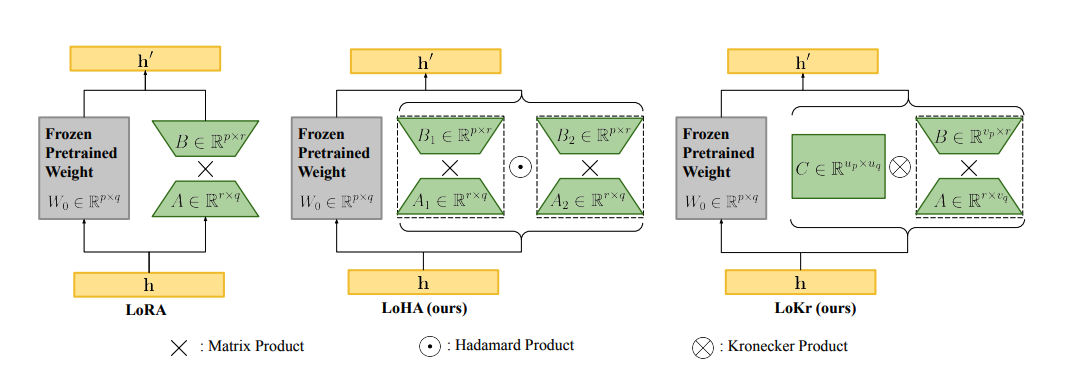
Low-Rank Kronecker Product (LoKr), is a LoRA-variant method that approximates the large weight matrix with two low-rank matrices and combines them with the Kronecker product. LoKr also provides an optional third low-rank matrix to provide better control during fine-tuning. By expresseing the weight update matrix as a decomposition of a Kronecker product, creating a block matrix, LoKr is able to preserve the rank of the original weight matrix. The size of the smaller matrices are determined by its rank or r. Another benefit of the Kronecker product is that it can be vectorized by stacking the matrix columns. This can speed up the process because you're avoiding fully reconstructing ∆W.
The abstract from the paper is:
Text-to-image generative models have garnered immense attention for their ability to produce high-fidelity images from text prompts. Among these, Stable Diffusion distinguishes itself as a leading open-source model in this fast-growing field. However, the intricacies of fine-tuning these models pose multiple challenges from new methodology integration to systematic evaluation. Addressing these issues, this paper introduces LyCORIS Lora beYond Conventional methods, Other Rank adaptation Implementations for Stable diffusion, an open-source library that offers a wide selection of fine-tuning methodologies for Stable Diffusion. Furthermore, we present a thorough framework for the systematic assessment of varied fine-tuning techniques. This framework employs a diverse suite of metrics and delves into multiple facets of fine-tuning, including hyperparameter adjustments and the evaluation with different prompt types across various concept categories. Through this comprehensive approach, our work provides essential insights into the nuanced effects of fine-tuning parameters, bridging the gap between state-of-the-art research and practical application.
Usage
from peft import LoKrConfig, get_peft_model

config = LoKrConfig(
    r=16,
    alpha=16,
    target_modules=["query", "value"],
    module_dropout=0.1,
    modules_to_save=["classifier"],
)
model = get_peft_model(model, config)
model.print_trainable_parameters()
"trainable params: 116,069 || all params: 87,172,042 || trainable%: 0.13314934162033282"
Benchmark overview
API
LoKrConfig
autodoc tuners.lokr.config.LoKrConfig
LoKrModel
autodoc tuners.lokr.model.LoKrModel