 wehub-resource-sync
caf324b09d
wehub-resource-sync
caf324b09d
4.0 KiB
Prompt tuning
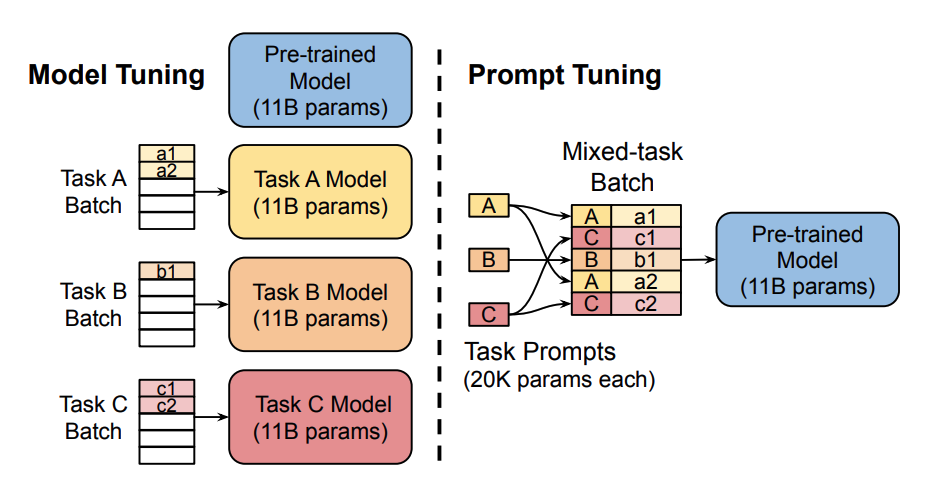
Prompt tuning adds a task-specific, virtual prompt to the input that consists of trainable vectors in the embedding space. The virtual token parameters are updated independently of the pretrained model parameters which are frozen.
The abstract from the paper is:
In this work, we explore "prompt tuning", a simple yet effective mechanism for learning "soft prompts" to condition frozen language models to perform specific downstream tasks. Unlike the discrete text prompts used by GPT-3, soft prompts are learned through backpropagation and can be tuned to incorporate signal from any number of labeled examples. Our end-to-end learned approach outperforms GPT-3's "few-shot" learning by a large margin. More remarkably, through ablations on model size using T5, we show that prompt tuning becomes more competitive with scale: as models exceed billions of parameters, our method "closes the gap" and matches the strong performance of model tuning (where all model weights are tuned). This finding is especially relevant in that large models are costly to share and serve, and the ability to reuse one frozen model for multiple downstream tasks can ease this burden. Our method can be seen as a simplification of the recently proposed "prefix tuning" of Li and Liang (2021), and we provide a comparison to this and other similar approaches. Finally, we show that conditioning a frozen model with soft prompts confers benefits in robustness to domain transfer, as compared to full model tuning.
In contrast to prefix tuning, only the input of the first layer receives the virtual tokens.
Usage
There are two decisions to take: how many virtual tokens are added to the
input of the model (num_virtual_tokens) - this will define how many
trainable parameters there will be - and how these tokens are initialized.
Create a [PromptTuningConfig] with the task type, the initial prompt tuning text to train the model with, the number of virtual tokens to add and learn, and a tokenizer.
from peft import PromptTuningConfig, PromptTuningInit, get_peft_model

prompt_tuning_init_text = "Classify if the tweet is a complaint or no complaint.\n"
peft_config = PromptTuningConfig(
    task_type="CAUSAL_LM",
    prompt_tuning_init=PromptTuningInit.TEXT,
    num_virtual_tokens=len(tokenizer(prompt_tuning_init_text)["input_ids"]),
    prompt_tuning_init_text=prompt_tuning_init_text,
    tokenizer_name_or_path="bigscience/bloomz-560m",
)
model = get_peft_model(model, peft_config)
model.print_trainable_parameters()
"trainable params: 8,192 || all params: 559,222,784 || trainable%: 0.0014648902430985358"
Benchmark overview
API
PromptTuningConfig
autodoc tuners.prompt_tuning.config.PromptTuningConfig
PromptEmbedding
autodoc tuners.prompt_tuning.model.PromptEmbedding