 wehub-resource-sync
caf324b09d
wehub-resource-sync
caf324b09d
3.9 KiB
P-tuning
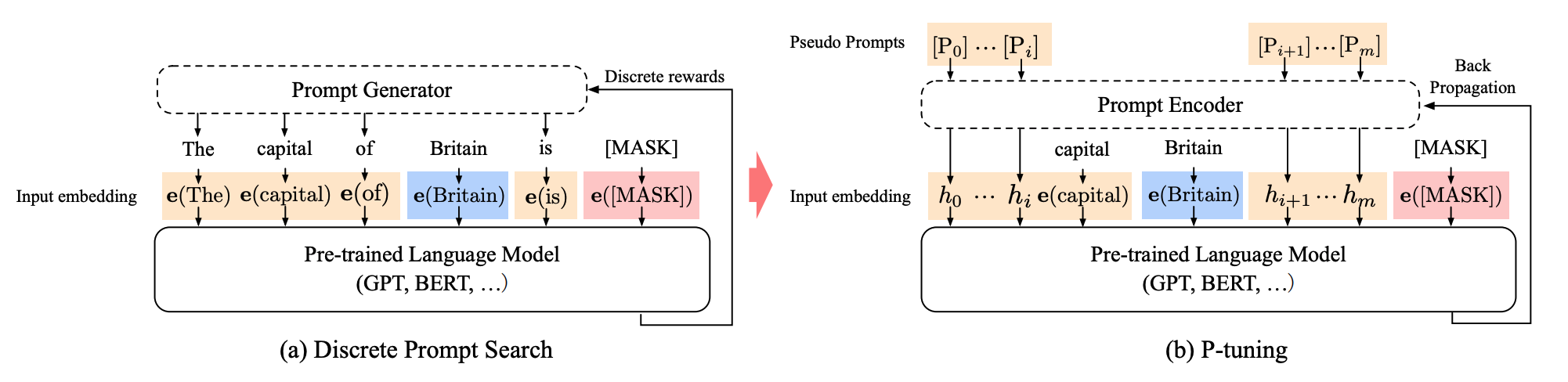
P-tuning is designed for natural language understanding (NLU) tasks and all language models.
The abstract from the paper is:
While GPTs with traditional fine-tuning fail to achieve strong results on natural language understanding (NLU), we show that GPTs can be better than or comparable to similar-sized BERTs on NLU tasks with a novel method P-tuning -- which employs trainable continuous prompt embeddings. On the knowledge probing (LAMA) benchmark, the best GPT recovers 64% (P@1) of world knowledge without any additional text provided during test time, which substantially improves the previous best by 20+ percentage points. On the SuperGlue benchmark, GPTs achieve comparable and sometimes better performance to similar-sized BERTs in supervised learning. Importantly, we find that P-tuning also improves BERTs' performance in both few-shot and supervised settings while largely reducing the need for prompt engineering. Consequently, P-tuning outperforms the state-of-the-art approaches on the few-shot SuperGlue benchmark..
The method adds trainable prompt embeddings to the input that is optimized by a prompt encoder to find a better prompt, eliminating the need to manually design prompts. The prompt tokens can be added anywhere in the input sequence, and p-tuning also introduces anchor tokens for improving performance. A prompt encoder (a bidirectional long-short term memory network or LSTM) is used to optimize the prompt parameters. Unlike prefix tuning:
- the prompt tokens can be inserted anywhere in the input sequence, and it isn't restricted to only the beginning
- the prompt tokens are only added to the input instead of adding them to every layer of the model
- introducing anchor tokens can improve performance because they indicate characteristics of a component in the input sequence
The paper's results suggest that P-tuning is more efficient than manually crafting prompts, and it enables GPT-like models to compete with BERT-like models on NLU tasks.
Usage
Create a [PromptEncoderConfig] with the task type, the number of virtual tokens to add and learn, and the hidden size of the encoder for learning the prompt parameters.
from peft import PromptEncoderConfig, get_peft_model

peft_config = PromptEncoderConfig(task_type="CAUSAL_LM", num_virtual_tokens=20, encoder_hidden_size=128)
model = get_peft_model(model, peft_config)
model.print_trainable_parameters()
"trainable params: 300,288 || all params: 559,514,880 || trainable%: 0.05366935013417338"
Benchmark overview
API
PromptEncoderConfig
autodoc tuners.p_tuning.config.PromptEncoderConfig
PromptEncoder
autodoc tuners.p_tuning.model.PromptEncoder