# LoKr
Navigating Text-To-Image Customization: From LyCORIS Fine-Tuning to Model Evaluation
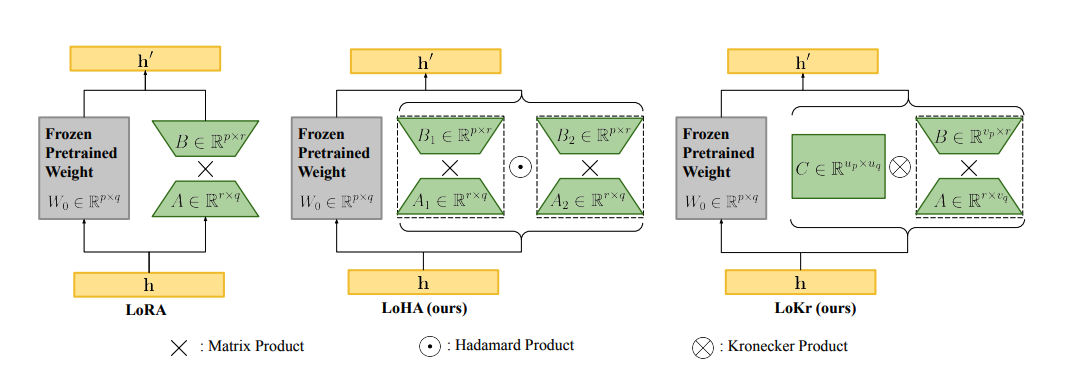
Low-Rank Kronecker Product ([LoKr](https://hf.co/papers/2309.14859)), is a LoRA-variant method that approximates the large weight matrix with two low-rank matrices and combines them with the [Kronecker product](https://en.wikipedia.org/wiki/Kronecker_product). LoKr also provides an optional third low-rank matrix to provide better control during fine-tuning. By expresseing the weight update matrix as a decomposition of a Kronecker product, creating a block matrix, LoKr is able to preserve the rank of the original weight matrix. The size of the smaller matrices are determined by its *rank* or `r`. Another benefit of the Kronecker product is that it can be vectorized by stacking the matrix columns. This can speed up the process because you're avoiding fully reconstructing ∆W.
The abstract from the paper is:
*Text-to-image generative models have garnered immense attention for their ability to produce high-fidelity images from text prompts. Among these, Stable Diffusion distinguishes itself as a leading open-source model in this fast-growing field. However, the intricacies of fine-tuning these models pose multiple challenges from new methodology integration to systematic evaluation. Addressing these issues, this paper introduces LyCORIS [Lora beYond Conventional methods, Other Rank adaptation Implementations for Stable diffusion](https://github.com/KohakuBlueleaf/LyCORIS), an open-source library that offers a wide selection of fine-tuning methodologies for Stable Diffusion. Furthermore, we present a thorough framework for the systematic assessment of varied fine-tuning techniques. This framework employs a diverse suite of metrics and delves into multiple facets of fine-tuning, including hyperparameter adjustments and the evaluation with different prompt types across various concept categories. Through this comprehensive approach, our work provides essential insights into the nuanced effects of fine-tuning parameters, bridging the gap between state-of-the-art research and practical application.*
## Usage
```py
from peft import LoKrConfig, get_peft_model
config = LoKrConfig(
r=16,
alpha=16,
target_modules=["query", "value"],
module_dropout=0.1,
modules_to_save=["classifier"],
)
model = get_peft_model(model, config)
model.print_trainable_parameters()
"trainable params: 116,069 || all params: 87,172,042 || trainable%: 0.13314934162033282"
```
## Benchmark overview
# API
## LoKrConfig
[[autodoc]] tuners.lokr.config.LoKrConfig
## LoKrModel
[[autodoc]] tuners.lokr.model.LoKrModel